

 Responsive Menu
Responsive Menu
Responsive Menu

Healthcare Marketing Agency vs In-House Team
You're weighing a headcount request against a retainer, and the right answer depends on which problem is actually blocking patient growth. Here's the cost math, the trade-offs on both sides, and the hybrid model most hospitals and health systems land on.

Every budget cycle, the same line item gets circled. A senior marketing hire, or a retainer with an outside firm. Your CFO wants one number. Your board wants patient volume, and wants it explained in a way that holds up in the next meeting.
The instinct is to treat this as a cost question. Cost is the easy part. The harder question is what's actually broken, because hiring the wrong kind of help for the wrong problem is how both options end up disappointing you. A capacity problem and a judgment problem look identical on a dashboard and need completely different fixes.
Hire an outside healthcare marketing agency when the problem is judgment rather than capacity. If positioning, service-line messaging, or brand architecture is what's holding back patient volume, more hands won't move it. A senior outside team reaches the diagnosis faster than a new hire who needs two quarters just to learn your organization.
You can usually tell which one you have. Capacity problems sound like a backlog: campaigns ship late, the content calendar slips, nobody owns the website. Judgment problems sound like confusion: spend goes up and appointments don't, patients know one service line and miss four others, your messaging could be lifted onto a competitor's site without anyone noticing. The second kind is where outside senior perspective earns its keep, and it's the pattern behind most of the patient acquisition work we take on.
Timing matters too. A merger, a new service line, a system rebrand, or a website that's become a liability all create a window where the cost of a slow answer is higher than the cost of outside help. If you're mid-transition, waiting six months to hire, onboard, and ramp a director is itself a decision with a price.
More than the salary line suggests. The Bureau of Labor Statistics puts the median wage for marketing managers at $161,030 as of May 2024, per its wage data. Standard planning practice is to load that by roughly 1.25 to 1.4 times for benefits, payroll tax, tooling, and recruiting, which puts one senior hire somewhere above $200,000 a year before a dollar of media spend. Treat that multiplier as a planning assumption and check it against your own finance team's loaded-cost figure.
Then comes the part budgets tend to miss. One senior generalist rarely covers brand strategy, information architecture, content production, technical search, video, and analytics. Health systems that go fully in-house usually discover they've hired a coordinator for freelancers, and the coordination overhead lands right back on your desk. Meanwhile marketing budgets are getting tighter, not looser: Gartner's 2026 CMO spend survey found budgets plateaued at 7.8% of company revenue, and The CMO Survey tracks the same pressure from the practitioner side.
| What you're deciding | Fully in-house | Outside agency | Hybrid |
|---|---|---|---|
| Best when | Steady volume of known, repeatable work | Positioning, brand, or web is the blocker | You own the relationships, we own the heavy lifts |
| Real cost driver | Loaded salary plus tooling plus recruiting | Scoped engagement tied to a defined outcome | One internal owner plus project-based senior support |
| Time to first output | Search, hire, onboard, ramp | Weeks, with a diagnosis up front | Immediate on the outside workstream |
| Institutional knowledge | Strongest, and it compounds | Learned fast, documented, handed back | Stays with your team by design |
| Range of skills covered | Narrow per hire | Full senior bench on demand | Internal depth plus outside breadth |
| Main risk | One person becomes a single point of failure | A partner who never learns your clinical reality | Unclear ownership if the split isn't written down |
82% of ANA member marketers now run an in-house agency, up from 42% in 2008. In the same research, 88% said their in-house workload rose in the past year, and 67% said it rose a lot.
Source: ANA, The Continued Rise of the In-House Agency
Read that trend carefully, because it cuts both ways. Bringing work in-house is now normal, and the teams that did it are drowning. That's the real 2026 question: not whether to build a team, but what that team should stop trying to absorb.

Proof, Not Promises




The work that needs senior judgment and a full bench, done in weeks instead of quarters. It usually lands in the same six places, and you should know which one you're buying before you sign anything.
Most engagements start with brand, because that's usually where the problem is hiding. Walk the exhibit hall at any health system conference and the promises blur into one: trusted, compassionate, patient-centered, nationally recognized. Everybody thinks their version sounds different. Patients can't tell them apart. Positioning is finding the thing that's true about you, provable, and not already claimed by the hospital twenty minutes down the road.
That sameness gets expensive on your website, which is where most healthcare organizations lose people. Sites drift into org-chart shape: a page per department, a menu built the way the institution is organized instead of the way a worried family searches at ten at night. Build around how patients, families, and referrers actually decide and you'll beat a prettier site every time.
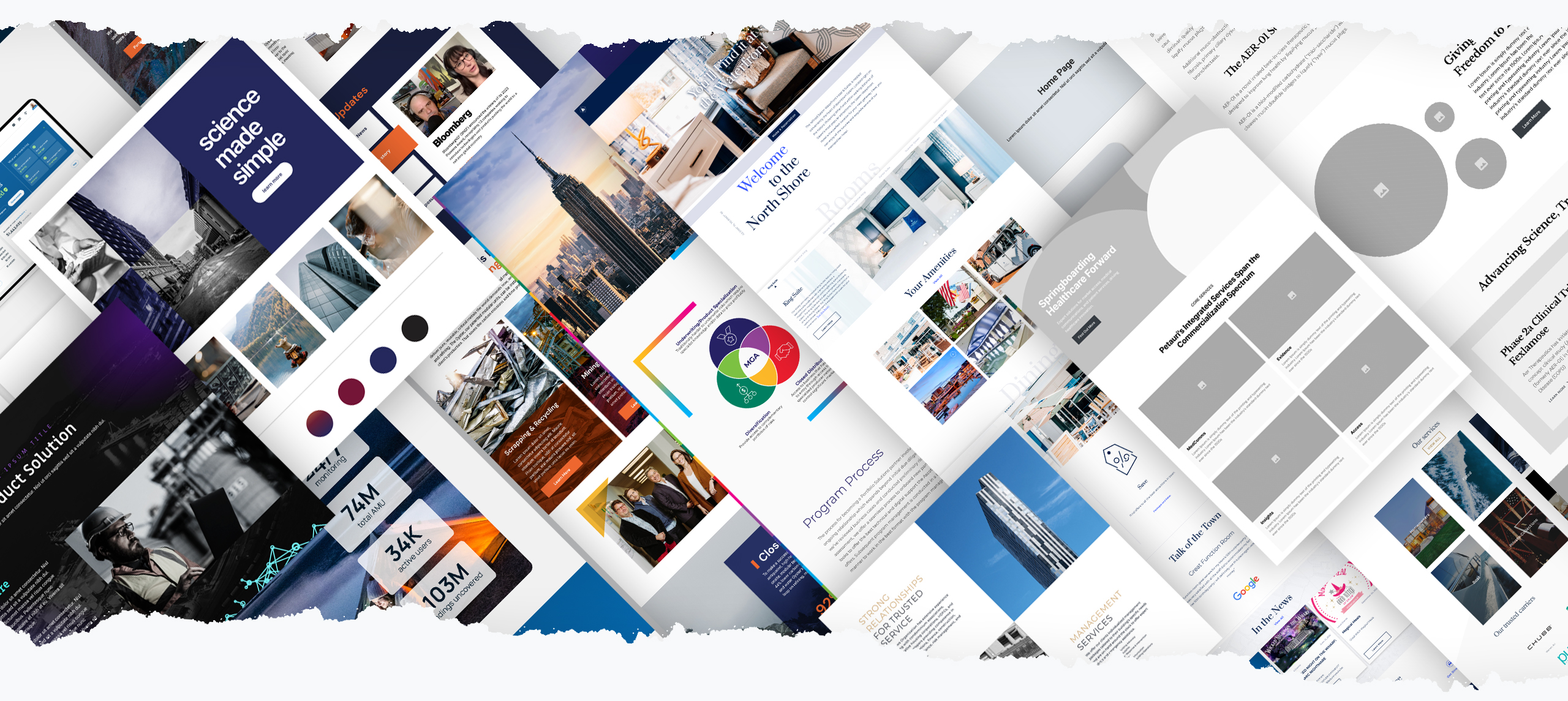
Then content, which in healthcare means turning expertise your physicians already have into authority a search engine and a patient both recognize. That same work now has to be readable by machines too, which is what our AI-assisted content practice is for: structured so it can be cited, with a human expert over every clinical claim.
The last two are the ones internal teams ask for help with most. Campaigns measured in booked appointments instead of clicks, because impressions don't fill a schedule. And video, still the fastest way to get a community to trust a clinician it's never met. Neither one is a full-time hire. Together they're most of a department.
Bring pattern recognition from outside your organization, and bring it at senior level from day one. An agency that has repositioned a health system, rebranded a home care company, and rebuilt a PACE program's digital presence has seen how those problems resolve. Your first internal hire, however good, has seen one organization.
The second thing is range without headcount. A brand strategist, an information architect, a content lead, a search and AEO specialist, and a video team are five hires and roughly a million dollars of loaded payroll. As a scoped engagement, they're a project. That arithmetic is why a lot of healthcare organizations use outside help for the foundational work and keep their internal team on everything that runs daily.
The third is speed on things that have a deadline attached. A merger announcement, a service-line launch, or a website redesign doesn't wait for a search committee.
Relationships, institutional memory, and anything that needs a decision today. Nobody outside your organization should be the only person who knows which service-line chief will approve copy, how your referral network really behaves, or what the board heard last quarter. That knowledge is an asset and it should compound internally.
Day-to-day operations belong inside too: social channels, community and event work, physician liaison support, internal communications, and the fast-turn requests that surface every week. Outside partners are poorly suited to work measured in hours. And a competent internal owner is what makes an agency engagement work at all, because someone has to hold the thread, make calls, and keep the organization moving between sessions.
Six questions separate a partner who will understand your organization from a vendor who will send you a template.
Ask for named organizations and the specific outcome, not a logo wall. Hospital, home care, PACE, and health tech are different problems, and experience in one doesn't transfer cleanly to another.
Find out whether the senior people in the room stay on the account. A pitch team that hands you to junior staff at kickoff is the most common way these engagements go quiet.
A partner who quotes a deliverable before understanding whether your problem is positioning or execution is selling inventory. Ask what the first two weeks look like.
Forms, scheduling, chat, and tracking scripts all touch protected information under the HIPAA marketing rules, and your site needs to meet WCAG 2.2. Ask how both are handled, and by whom.
Strategy, messaging architecture, and documentation should live with you when the engagement ends. A partner who keeps the thinking is building dependency, not capability.
Ask specifically about structured data, entity clarity, and answer-shaped content. Most agencies are still catching up here, and the ones that aren't will say so concretely.
One internal owner, plus outside senior help on the foundational work. That means your director or VP of marketing runs the relationships, the calendar, and the daily operation, while an outside team handles brand and positioning, the website rebuild, the content engine, and search and AEO. Ownership gets written down at the start, so nobody is guessing who decides what.
This is where most of the health systems, medical groups, home care companies, and health tech firms we work with end up. The reason it holds up is that it matches the actual shape of the work: some marketing is continuous and local, and some is episodic and specialized. Staffing both patterns the same way is what breaks budgets.
It also fits the pressure everyone is under. Gartner found 39% of CMOs planning to cut agency budgets in 2026, mostly by ending unproductive relationships and streamlining rosters. Most of them aren't dropping outside help so much as narrowing it down: fewer partners, more senior ones, on work that clearly needs them.
Patients and referrers now start in AI assistants, and being invisible there is a new failure mode that neither a bigger internal team nor a traditional agency automatically fixes. When someone asks ChatGPT or Perplexity for a specialist, the answer names some organizations and skips others, and the reasons it skips you are structural.
That capability is scarce right now, which changes the hiring calculus. You can't reliably recruit for it yet, and most agencies are still selling search the way they did in 2022. Getting cited depends on complete structured data that declares who you are and what you treat, content written to answer the question a patient actually asked, and consistent information across every directory that describes you. We've written up how that works for healthcare organizations in our guide to AEO in 2026.
The broader context makes the timing sharper. Deloitte's 2026 health care outlook found 43% of executives uncertain or neutral about the near-term industry picture, up from 28% a year earlier, with 80% saying regulatory and policy factors will shape their 2026 strategy. Its CFO survey found 59% expecting M&A to rise as a priority. More consolidation means more brand architecture decisions, and those are exactly the decisions that go badly without senior outside perspective.
The Decision, Simply Put
Name the problem out loud first, because the answer changes with it. If your team is shipping good work late, that's capacity, and a hire will pay off for years. If spend is climbing while appointments stay flat, that's judgment, and more hands won't touch it.
Most organizations we talk to have some of both, which is why the hybrid keeps winning: one internal owner who knows the building and the politics, outside senior help on brand, the website, and the AI-search work you want to get right the first time. Write down who decides what and it holds up.
What costs you is putting it off. Two more budget cycles go by, and patient volume drifts to the health system that already decided. A hire you make on purpose is a good outcome. A tightly scoped engagement is a good outcome. Another year circling the line item isn't.
If you're in the middle of it right now, bring it to us before it's settled. That's when an outside read is worth the most, and it costs you a conversation.
Award-Winning Healthcare Marketing

Elliot Hospital · Health System
Brand, campaigns, and digital content working together for one of New England's leading health systems.
Read Case Study
HouseWorks · Home Care
A new logo, visual identity system, and brand guidelines deployed across the full portfolio of services.
Read Case Study
Element Care · PACE
An integrated media and messaging program linking complex clinical services to the aging adults who need them.
Read Case Study
Talk to a Healthcare Marketing Agency
If you're weighing a hire against outside help, we're happy to talk it through and tell you which one your situation actually calls for. Sometimes that answer is a hire, and we'll say so. No pitch deck, no pressure, just a real conversation about what's in the way of patient growth.
Tell us a bit about what you're working on. KingFish + Partners will reach out within one business day.
Straight Answers for Healthcare Leaders
It depends on whether your problem is judgment or capacity. If positioning, brand, or your website is what's blocking patient volume, an outside senior team gets you to the answer faster and cheaper than a new hire who needs two quarters to ramp. If you have a steady stream of known, repeatable work, an internal hire compounds value. Most hospitals and health systems land on a hybrid: one internal owner, outside senior help on the foundational work.
A single senior marketing hire runs above $200,000 a year once you load benefits, tooling, and recruiting onto a median marketing manager wage of $161,030. An agency engagement is scoped to a defined outcome instead of a salary, so you're buying a specific result with a full senior bench behind it. The useful comparison isn't retainer versus salary, it's what each option actually delivers against the patient growth number your board is watching.
We work across the full range of healthcare: hospitals and health systems, regional and community hospitals, multi-specialty medical groups and physician practices, dental practices and DSOs, chiropractic and rehabilitation practices, behavioral and mental health providers, home care, hospice, and PACE organizations, senior living, and digital health, health tech, and medical device companies. If your organization serves patients or the people who care for them, we can help.
When what you actually need is someone in the building every day. Social channels, community and event work, physician liaison support, internal communications, and fast-turn requests measured in hours all belong inside. If that's the bulk of the gap, hire. An agency is the wrong instrument for work that needs a decision before lunch.
A focused engagement produces a diagnosis in the first couple of weeks and shipped work in weeks after that. A healthcare website rebuild typically runs 6 to 8 weeks with a strategy-led partner. Patient volume moves on a longer clock because care decisions do, but you should see leading indicators, qualified inquiries and appointment requests, well before the lagging ones.
Your director or VP of marketing owns relationships, the calendar, and daily operations. An outside team owns brand and positioning, the website, the content engine, and search and AEO. Ownership is written down at kickoff so nobody guesses who decides what, and strategy and documentation get handed back to your team as the work completes.
Yes, and you should ask exactly how. Contact forms, appointment requests, chat tools, and the tracking scripts behind them all touch information covered by the HIPAA marketing rules, and your site should meet WCAG 2.2 for accessibility. A healthcare specialist builds privacy-aware forms and data handling into the site rather than bolting compliance on after launch.
Often yes, for different work. ANA research shows 82% of member marketers now run an in-house agency, and 88% of them say their workload rose in the past year. Internal teams rarely have spare capacity for a rebrand, a site rebuild, or an AI-search program on top of everything they already run. That's the split worth funding.
Your site needs complete structured data declaring who you are, what you treat, where you operate, and what you accept, plus content that answers patient questions in plain language and consistent information across directories. This practice is called answer engine optimization, and it's a core part of how KingFish + Partners builds healthcare sites, so a single build serves Google crawlers, AI assistants, and the person reading the page.
Three things help most: the patient growth number you're accountable for, what you've already tried and what happened, and who inside the organization has to say yes. You don't need a brief or a budget range to have a useful first conversation, and coming in with open questions rather than a spec usually gets you a better diagnosis.
If This Feels Familiar, Let's Sit Down
Written by Cam Brown. Cam is President and CEO of KingFish + Partners, an independent B2B marketing agency in Beverly, Massachusetts that helps hospitals, health systems, home care companies, and health tech firms restart patient growth. Reviewed by the B2B Review Board.