

 Responsive Menu
Responsive Menu
Responsive Menu

Financial services website redesign, SEO, and AI discovery
Most financial services and fintech companies lose pipeline to one of two problems: not enough high-intent traffic from the buyers who matter, or buyers who arrive and never convert. A financial services website redesign that works has to fix both. Here's what that actually takes in 2026.

The two ways a financial services website fails
Almost every underperforming financial services and fintech site we're asked to look at is failing in one of two specific ways. Naming which one you're dealing with changes what the redesign has to do.
Problem 01
Your site isn't visible to the CFOs, CCOs, treasurers, and RIA principals who are actively searching on Google or asking AI assistants which vendors and advisors to evaluate.
Problem 02
The right buyers arrive, look around, and leave without booking a demo, requesting a proposal, or reaching out to your team at all.
These two problems share a root cause. A site that isn't built around a clear picture of who your ideal buyer is, what they're searching for, and what earns their trust will fail on both counts. It won't surface when those buyers search, and when it does surface, it won't convert them.
For fintech companies, payments platforms, community banks, credit unions, RIAs, neobanks, insurers, and regtech providers competing in some of the most crowded and most heavily regulated B2B markets in the country, getting financial services website design right isn't a marketing nice-to-have. It's a direct driver of pipeline, valuation, and growth.

Financial services SEO and buyer-intent traffic
By rebuilding the site around the questions your buyers actually type, not the way your product team names its modules. If your site isn't surfacing when your best prospects search, the problem is almost never ad spend.
Financial services buyers do specific, intent-driven research long before they fill out a form. A CFO evaluating an embedded payments provider isn't searching "payment solutions." They're searching "embedded payments for B2B SaaS" or "card issuing platform for marketplaces," and they'll only engage with vendors whose sites immediately show fluency with their regulatory and operational reality. An RIA competing for high-net-worth households isn't searching "wealth management." They're searching "fee-only advisor for business owners selling a company." Generic positioning doesn't reach these buyers. Specificity does.
Most financial services and fintech websites are structured around internal product names: ACH, Wires, Cards, Compliance Modules. Buyers don't search that way. A payments platform restructured around buyer contexts, like "embedded payments for vertical SaaS" or "BSA compliance software for community banks," captures the searches that matter. Sites organized around internal naming don't. This is the difference between financial services SEO that generates pipeline and a keyword list that generates a report.
Page structure, crawlability, site speed, internal linking, and schema markup all determine whether Google surfaces your site for the financial services searches that matter. Plenty of bank website design and fintech web design projects are built for board credibility and visual polish with little attention to the technical signals that drive organic pipeline: impressive on the surface, invisible to the buyers who'd convert. Fast loading, clear semantic headings, pages organized by buyer role and use case, and proper structured data send the signals Google needs. For financial firms that includes the FinancialService entity types most redesigns skip entirely.
When a CFO at a regional bank asks ChatGPT "what are the best core banking platforms for a community bank?", is your company in that answer? When a compliance officer asks Perplexity "which regtech vendors handle BSA and AML for credit unions?", does your name appear? For most financial services and fintech companies the answer is no, and they don't know it. We build for AI discovery in every engagement.
Conversion, positioning, and buyer trust in financial services
Because conversion is downstream of conviction. You can't design your way to pipeline from a page that hasn't earned the buyer's trust and given them a specific reason to act.
Traffic exists, paid or organic or both. But demo requests are thin, proposal conversations stall, or sales tells you the inbound leads aren't qualified. The instinct is to treat this as a design problem: better CTAs, a shorter form, a cleaner homepage. That rarely fixes it.
In financial services the trust bar is higher than in almost any other B2B category. A CCO recommending a compliance platform is putting their professional reputation and their firm's regulatory standing on the line. An RIA competing for high-net-worth households is asking someone to hand over their life's savings. A treasurer selecting a payments provider knows their choice will be reviewed by a board and an auditor. These buyers evaluate credibility before they evaluate capability, and that judgment starts on your homepage.
In financial services, buyers evaluate credibility before capability. If your proof is three clicks deep, you've already lost the evaluation.
Cam Brown, President & CEO, KingFish + PartnersA payments platform serving SaaS, e-commerce, and healthcare shouldn't use one homepage for all three. Each buyer has a different problem, a different approval process, and a different trust threshold. Pages built around "treasury automation for CFOs at multi-entity businesses" rather than "our treasury module" lift relevance and financial services lead generation together.
A CCO evaluating compliance technology cross-references claims, hunts for gaps, and tries to form a judgment about whether you understand their regulatory environment. Your page flow has to surface the right proof at the right moment: regulatory and security credibility early, peer validation and named outcomes mid-page, and a frictionless next step at the end.
"Seamless," "scalable," and "trusted" appear on every competitor's homepage. An RIA that positions around "helping successful business owners move from accumulation to distribution after an exit" attracts a different quality of conversation than one leading with "comprehensive wealth management solutions." The positioning work upstream of a redesign determines whether the finished site earns conviction or just records visits.
Named client logos, specific outcome metrics, assets under management, transaction volume, SOC 2 and regulatory credentials: these belong within the first screen, not three clicks into a resources section. Specificity earns trust. A firm that leads with a named client and a real number earns more credibility than one claiming to be "trusted by leading institutions nationwide."
AI discovery for financial services websites
Financial services website strategy has had two chapters. Chapter three has already started, and it changes what a redesign has to deliver.
Chapter one was building for human visitors: clear navigation, credible copy, conversion-optimized UX. Chapter two added Google as a second audience, which brought SEO-informed architecture, keyword strategy, and page structure that drives organic discovery. Chapter three is AI. A payments CFO today is as likely to open ChatGPT and ask "what are the best embedded payments platforms for B2B SaaS?" as they are to run a Google search. Redesign a financial services website in 2026 without treating AI discovery as a first-class requirement and you'll launch a site optimized for a world that no longer exists.
Audience 01
The CFO, CCO, treasurer, or RIA principal who needs to see their specific regulatory and operational situation reflected back within the first ten seconds.
Audience 02
Crawlers evaluating technical structure, keyword relevance, page authority, and ranking signals for the financial services queries your buyers use in evaluation mode.
Audience 03
ChatGPT, Gemini, Claude, and Perplexity, answering when buyers ask which providers to shortlist, what to look for in a platform, or who to trust with a mandate.
Answer engine and generative engine optimization
They're the two disciplines that decide whether your firm shows up when a buyer asks an AI which providers to shortlist.
AEO
Structuring your content so AI systems can accurately retrieve and cite it when buyers ask about platforms, providers, and advisors. AEO is to AI assistants what SEO is to Google.
GEO
Optimizing for visibility inside AI-generated responses, so your brand and positioning appear accurately when large language models synthesize answers about your category.
For financial services the stakes are high because the questions buyers ask AI are vendor-evaluative. "What regtech platforms do community banks use for BSA compliance?" "Which RIAs specialize in business owners planning an exit?" "What are the best core processing providers for a credit union under a billion in assets?" Those are active shortlist decisions, and most financial services websites are invisible when they're asked.
We've worked with financial services clients whose sites rank well on Google with strong domain authority yet are nearly invisible across ChatGPT, Gemini, and Claude. That's the default state for most financial services websites built before 2024. The gaps fall into two areas.
Front-end factors AI reads differently
Back-end structure most redesigns miss
Most of this isn't hard to fix once you know what you're looking at. The catch is that most agencies don't treat AEO and GEO as first-class deliverables, so it gets deprioritized or bolted on at the end. At KingFish + Partners we engineer all three audiences into every financial services engagement from the first day of strategy work, and carry it through content and web build.
Build vs buy for a financial services website redesign
It depends on what you're actually trying to fix. When the problem is executional, keeping it internal often makes sense. When it's strategic, it rarely does.
Internal teams have real advantages: deep product knowledge, no onboarding lag, easier post-launch iteration, and a standing relationship with compliance and legal. But the problems on this page, ICP-specific positioning, buyer-journey architecture, financial services SEO, and AI discovery, are strategic problems. They're hard to lead from inside the organizational dynamics that created them. Financial services firms feel this acutely: the people who know the product best are often the worst positioned to explain it to a buyer who has never seen it, and the review process that protects the firm tends to sand the specificity out of every claim.
Running it internally
Hiring a financial services marketing agency
Tired of generic playbooks pulled from giant industry reports like Deloitte's banking outlook, Accenture's banking trends, and HubSpot's marketing research? So are we. Those reports describe the category in aggregate. They can't tell you why your buyers bounce. We're a small, senior team, and the value of a fintech marketing partner here is almost entirely a function of whether they understand how regulated buyers evaluate and buy.
Talk to a financial services marketing agency
Whether your site isn't reaching the right buyers, isn't converting the traffic it gets, or both, we'll give you a direct read on what's happening and what a fix actually involves. You'll speak with senior people, not a junior discovery rep.
Award-winning financial services marketing
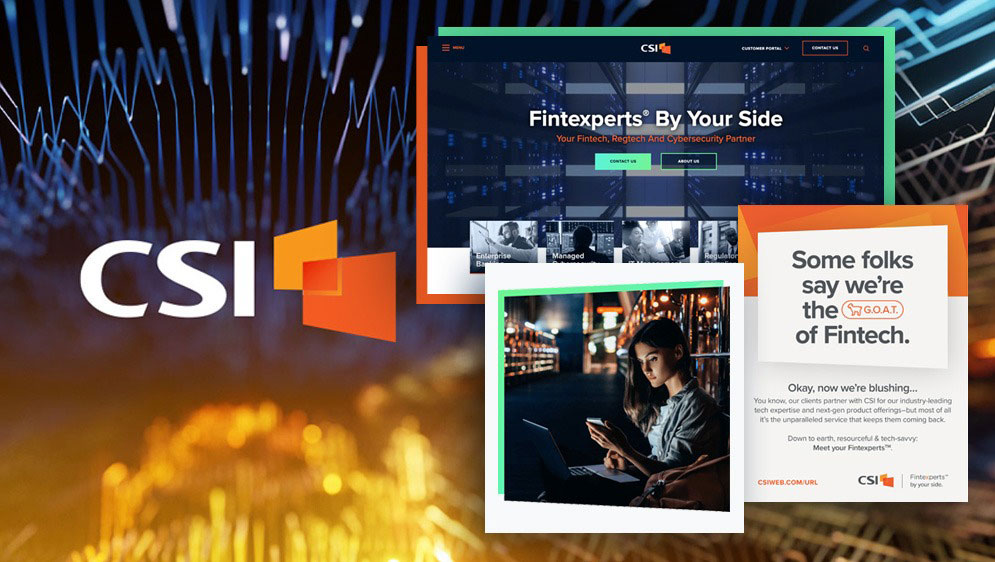
CSI · Banking technology
Positioning and campaign work that turns a five-decade fintech and regtech offering into a story bank and credit union buying committees can follow and act on.
Read case study
Truthifi · Fintech
Positioning, brand, and digital built to give a fintech innovator a distinct voice in a category where every competitor sounds the same.
Read case study
Nasdaq · Financial markets
Content and creative that connect a financial-markets brand to the institutional audiences whose attention is hardest to earn.
Read case studyMore on financial services marketing
Free consultation, no obligation
Send a note with your site and your growth goals. We'll come back with a direct read on whether the problem is traffic, conversion, AI visibility, or positioning, and what a realistic fix looks like. No pitch deck required.
Financial services website redesign questions
Meaningful financial services website redesigns, the ones that address positioning, ICP architecture, SEO, and AI discovery, typically range from mid-five figures for a focused engagement to six figures for full brand-plus-website work at firms with multiple product lines or buyer personas. The more useful question is pipeline ROI. If your site currently generates a thin flow of qualified inquiries and a redesign materially changes that, the investment pays back quickly. We scope against your specific situation in an initial free consultation.
A thorough financial services website redesign runs 3 to 5 months, covering discovery and positioning, information architecture, ICP and use-case landing pages, copywriting, design, development, and SEO and schema implementation. Build in extra time for compliance and legal review, which is the step most timelines underestimate in regulated categories. Compressed timelines are possible, but the tradeoff lands on the strategic and positioning work upstream, and that's precisely what determines whether the site generates qualified pipeline after launch or just looks better.
Financial services SEO applies search optimization to the vocabulary and evaluation behavior of regulated buyers. The keyword landscape maps to use-case and buyer-role terms rather than generic product categories: "embedded payments for B2B SaaS" or "BSA compliance software for community banks" rather than "payment solutions." It also demands content depth around regulatory environments, security credentials, and the business outcomes buyers answer to, because financial buyers research extensively before they ever submit a form, and the sites they find authoritative are the ones that speak most specifically to their context.
Three things. The trust bar is higher, so proof, credentials, and named outcomes have to carry more weight and appear earlier. The review cycle is longer, so the site has to survive compliance without losing the specificity that makes it persuasive. And the buying committee is wider, so a single page often has to satisfy a CFO, a CCO, and an auditor at once. Good financial services web design solves for all three at the same time rather than treating compliance as a constraint applied at the end.
Answer engine optimization structures your content so AI systems like ChatGPT, Claude, Gemini, and Perplexity can accurately retrieve and cite it when buyers ask about platforms, providers, and advisors. As more financial services buyers use AI to build initial shortlists before they visit a single vendor site, firms whose sites are built for AI retrieval will appear in those answers. AEO in financial services needs content structured as direct answers to buyer questions, comprehensive schema markup, clear entity definition, and navigation and headings that use buyer vocabulary rather than internal product naming.
Generative engine optimization targets visibility inside AI-generated responses, so that when a large language model synthesizes an answer about your category, your firm appears accurately and favorably. For fintech it matters because the questions buyers ask AI shape vendor shortlists before a single sales call happens. GEO is built from consistent, authoritative entity signals across your site and third-party profiles like Crunchbase, G2, LinkedIn, and partner directories, plus content depth around your specific use cases and the buyer roles that matter most.
The most common causes: the site attracts informational or early-stage research traffic rather than buyers in active evaluation mode; the homepage is too broad, speaking to every possible persona and resonating with none of them; positioning leans on generic adjectives rather than a specific point of view buyers remember; and proof is buried, so client names, outcome metrics, and regulatory credentials aren't visible early enough for buyers who evaluate credibility before capability.
If the problem is executional, like a visual refresh, a CMS migration, or page speed, internal ownership often works well when you have capable designers and developers in-house. If the problem is strategic, like unclear positioning, weak SEO architecture, low conversion from organic traffic, or AI invisibility, an external agency with genuine category expertise tends to produce better outcomes faster. The specific advantage is pattern recognition: having seen the same positioning and conversion problems across multiple financial services and fintech firms, and knowing which interventions actually move pipeline.
AI visibility is driven by content structure, schema markup, entity definition, and how clearly your site establishes what your firm does, who it serves, what problem it solves, and what category it operates in. For financial services specifically: implement comprehensive JSON-LD defining your organization, service categories, regulatory standing, and target buyer roles; create content that directly answers the vendor-evaluative questions your buyers ask AI; make sure navigation and headings use buyer vocabulary rather than internal product naming; keep entity signals consistent across your site and third-party directory profiles; and build content depth around your specific use cases and buyer roles.
It can if the rebuild is treated as a visual refresh, and that risk is avoidable. Most losses come from changed URLs without redirects, dropped schema, and pages that get thinned or removed during migration. We scope SEO and AEO preservation into the redesign from the start: mapping and redirecting every URL, carrying structured data forward, and protecting the pages and content that already earn organic rankings and AI citations. Handled this way, a redesign should protect or grow your pipeline visibility rather than reset it.
We work across the financial services landscape: fintech and payments platforms, community and regional banks, credit unions, RIAs and wealth management firms, neobanks and digital lenders, insurance carriers and brokers, asset managers and private equity firms, regtech and compliance software providers, core banking and processing vendors, mortgage lenders, and capital markets firms. The common thread is a considered purchase, a multi-stakeholder buying committee, a real regulatory context, and a buyer who researches extensively before ever talking to sales. Public data from the FDIC and the CFPB shapes how we frame the market, and your own buyers shape how we frame you.
About this article

Written by Cam Brown, President and CEO of KingFish + Partners. Cam has spent more than two decades building brands, websites, and content programs for financial services, fintech, and other regulated B2B companies, and works directly with the leadership teams who own the pipeline number.
Reviewed by the B2B Review Board. Published April 3, 2026 · Updated August 27, 2026.