

 Responsive Menu

Fintech marketing - customer acquisition cost and growth strategy
Fintech customer acquisition cost is climbing at growth-stage companies for a reason most boards miss. Paid media didn't stop working. It stopped covering for positioning that was never sharp enough, and the market picked 2026 to stop being forgiving. Here's how to tell which problem you actually have, and what to fix before you approve another budget increase.

The pattern behind rising fintech CAC
No wind to speak of. Water looked almost flat. From the beach you'd think it was still. But if you've ever been in a small motorboat out there, you know that look can fool you.
You throttle up. Engine sounds strong. RPMs are right where they should be. But the boat isn't tracking the way it should. You're moving. You can feel the power. And yet you're drifting off your line.
That's what growth-stage fintech CAC feels like right now. Budget's there. Campaigns are live. Something underneath has shifted.
I've had the same conversation with fintech CEOs for the past year. CAC's up. Not exploding, not crisis-level, just creeping. Quietly doubling over 18 months. So you do what smart operators do. Increase spend. Test new creative. Rotate agencies. Refine targeting. Add some AI optimization into the mix. And still it doesn't snap back.
I don't think that's a paid media problem. I think the current changed, and paid media stopped masking it.
You can't horsepower your way out of unclear positioning. But clarity, once built, compounds in ways paid media never can.
Cam Brown, President and CEO, KingFish + Partners
Fintech customer acquisition cost in 2026
Your fintech customer acquisition cost is rising because capital discipline came back to the market faster than marketing discipline did. From 2021 through 2023, abundant funding and growth-at-all-costs incentives insulated weak positioning. If differentiation wasn't tight, fine. If your messaging sounded like every other embedded finance company, fine. If the website read like a spec sheet, fine. As long as the chart climbed, nobody looked closely.
That insulation is gone. CB Insights put fintech deal volume down 25% quarter over quarter in Q2 2026, to 726 deals, the fewest in more than four years, with funding off 20% to $11.7 billion and most of that going to a handful of mega-rounds. Crunchbase tells the same story from the other end: $28.6 billion raised in the first half of 2026, up nearly 23% year over year, spread across 1,605 deals, down more than 25% from a year earlier. KPMG's Pulse of Fintech tracks the same concentration globally.
None of that means the sector shrank. More money went into fintech in the first half of 2026 than in the first half of 2025, and McKinsey's next age analysis has the category still outgrowing financial services overall. The money is there. It's just being placed later, in fewer companies, on stronger proof.
That's the part worth sitting with. The selectivity your investors are applying is the same selectivity your buyers are applying. Both are asking a version of one question: why this one, specifically? If your answer takes a minute to land, you pay for the delay in CAC.
The diagnostic question
Would your positioning convert if traffic were free? If someone landed on your homepage tomorrow at no cost, would they immediately understand who this is for, why it's different, and why it wins? If the answer is "mostly" or "kind of," you don't have a media problem. You have a conviction problem.
Fintech CAC diagnostic - four failure points
Positioning erodes at four points: your ICP widens, your narrative fragments across teams, your content gets safer, and paid media quietly turns into life support. None of it feels dramatic while it's happening. It's incremental, like a tide shift you don't notice until your heading is off by twenty degrees. There's one question that exposes each.
It never happens all at once. One quarter the ICP expands to include an adjacent segment. The next, messaging softens so it doesn't alienate the new verticals. By the time CAC is climbing, the brand no longer stands for anything specific, and nobody made a conscious decision to get there.
What to ask
Can every person on your sales and marketing team describe your ideal customer in the same words? If they can't, the ICP has drifted, and your media budget is now paying to reach people who were never going to buy.
Product says one thing. Sales says another. Marketing says a third. The website is six months behind all of them. When buyers do their own research, and they always do, they find a company that can't quite agree on what it is. That ambiguity is expensive. It forces the sales process to compensate for work the brand should have done.
What to ask
Does your homepage explain what you do in the language your best customers would use to describe you to a peer? If it doesn't, you're asking every buyer to translate before they can evaluate.
Differentiation softened because nobody wanted to alienate an adjacent buyer. Points of view disappeared. The blog started sounding like everyone else's blog. And then the AI systems that rank companies by how specifically and credibly they answer buyer questions started leaving you off the shortlist.
What to ask
Ask ChatGPT, Claude, and Perplexity about your category. Does your company come up? If it doesn't, that's a structural CAC problem, and answer engine optimization fixes it where no campaign can.
Spend rose to hold volume steady. Then it rose again. Somewhere in there the budget stopped amplifying a story and started substituting for one. That's the point where every incremental dollar buys a worse ratio, and where more spend reliably makes the numbers worse rather than better.
What to ask
If you paused paid entirely for 30 days, what would still generate pipeline? Whatever's left is your actual brand equity. Everything else is rented.
Positioning, demand, and media problems compared
Traffic that arrives and doesn't convert is a positioning problem. Traffic that never arrives at all is a demand problem. Traffic that converts but costs more every month is a media problem. Three different diseases, three different treatments, and spending more only helps the third one. Here's how each presents.
| What you're seeing | Positioning problem | Demand problem | Media problem |
|---|---|---|---|
| Search demand in your category | Healthy. Buyers are actively looking | Near zero. Nobody's searching for this yet | Healthy and competitive |
| What happens to your traffic | Arrives, then bounces or converts poorly | Never arrives at meaningful volume | Converts, but the price keeps climbing |
| What sales tells you | "They didn't understand what we do" | "We're educating a category from scratch" | "Leads are fine, we just need more of them" |
| Win rate against named competitors | Slipping, especially late in the cycle | No named competitors to lose to yet | Holding steady |
| What another 20% of budget does | Scales the ambiguity | Buys clicks from people who aren't buying | Works, at a worse ratio |
| Where to start | Sharpen the ICP, differentiation and narrative | Category education and demand creation | Channel mix, creative rotation and bidding |
Most growth-stage fintechs I talk to are convinced they're in column three and turn out to be in column one. The tell is the win rate. Media problems don't change who wins the deals you reach the end of. Positioning problems do, because the buyer got to the final round still unsure what you're for. We wrote up the full test in positioning or demand, and it's worth 10 minutes before your next budget conversation.
Fintech CAC benchmarks by acquisition channel
Far more depends on the channel than on the campaign. First Page Sage's fintech CAC benchmarks put B2B thought-leadership SEO at $647 per acquisition and account-based marketing at $4,664. That's a 7x spread inside one industry, before anyone touches a bid.
| B2B fintech channel | Cost per acquisition | What it depends on |
|---|---|---|
| Public speaking | $518 | Having a point of view worth a stage |
| Webinars | $603 | A specific question your buyers actually have |
| Thought leadership SEO | $647 | Published expertise that survives scrutiny |
| Social media marketing | $658 | A voice that sounds like a person, not a category |
| PPC and SEM | $802 | Whether the landing page converts what it rents |
| Video marketing | $815 | Story, not production value |
| Content marketing | $1,254 | Depth and consistency over volume |
| Trade shows | $1,390 | Being memorable in a room of near-identical booths |
| Account-based marketing | $4,664 | Account selection, and a reason they'd switch |
Two things stand out. First, everything at the cheap end is an authority channel, and authority channels only work when you have something specific to say. You can't buy your way into $647 acquisitions. You earn it by publishing a view your competitors can't copy, which is exactly the work that gets deferred when a quarter looks soft.
Second, PPC and SEM sit right in the middle at $802. That's a perfectly good number when your story converts and a punishing one when it doesn't. Paid media doesn't have a price problem. It has a multiplier problem, and your brand positioning sets the multiplier. Which is why we look at the foundation before we look at the media plan, and why our engagement model starts with a diagnosis rather than a channel recommendation.
AI search and the new fintech CAC floor
Because your buyers build the shortlist before they ever reach your site. Forrester's 2026 survey of nearly 18,000 business buyers found generative AI is now their most meaningful research source, ahead of vendor websites and sales reps. If a model can't describe what you do specifically, you're not in the consideration set, and no bid adjustment puts you there.
The supporting numbers all point the same direction. G2's Answer Economy study of 1,076 B2B buyers in March 2026 found 51% now begin the buying process in an AI chatbot rather than a search engine, and 69% ended up choosing a different vendor than they'd planned because of what the assistant told them. A Semrush survey of 622 US professionals is blunter still: 92% say AI has shaped their vendor shortlist, and only 7% notice a vendor because they recognize the brand, while 53% respond to a clear use-case fit.
Read that last pair together and the instruction is unusually clear. Being known isn't what gets you into the answer. Being specific is. That's a hard sentence for a fintech that spent three years buying awareness.
It doesn't mean people are out of the loop, either. Gartner's survey of 645 buyers found 45% used generative AI on a recent purchase and 69% still validate what it tells them with a sales rep. HubSpot's State of Marketing puts a number on how that feels from the inside: 61% of marketers say this is the biggest disruption their discipline has seen in 20 years.
What this changes in practice
The machine has to be able to say what you do, and then a human has to be able to verify it. That means specific, structured, checkable claims on pages built to be read by both, which is what our authority content and search visibility work is for. It's also why a website redesign that ignores structured data now costs you twice.




Award-winning fintech and financial services marketing
Three engagements where the fix was the story, not the spend. See All Work
Truthifi · Fintech
Brand, narrative and digital rebuilt so a fintech innovator reads as distinct instead of adjacent.
Read Case Study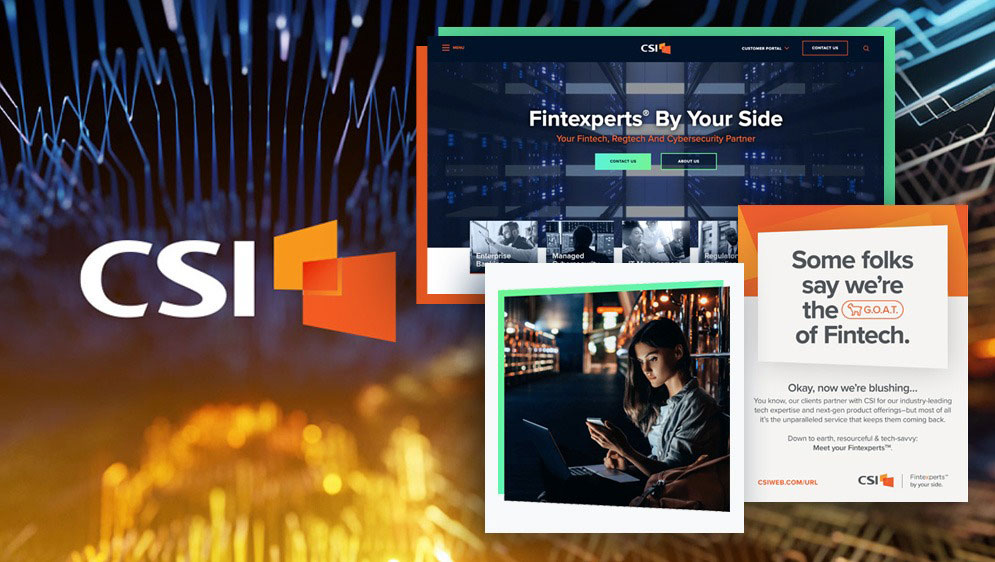
CSI · Banking technology
Integrated brand and campaign work for a major financial technology provider selling into cautious buyers.
Read Case Study
Nasdaq · Financial markets
Content and creative linking a financial-markets brand to the audiences that actually move its business.
Read Case StudyFintech and financial services marketing insights
Ranked #1
An independent ranking on strategic judgment, financial-services depth, and case work. See who leads.
Read ArticlePaid media strategy
What rising spend actually buys when the underlying story hasn't been fixed first.
Read ArticleIn-house or agency
How to decide between building the team and hiring the partner, without relitigating it in six months.
Read ArticleRelated reading: positioning or demand and fintech marketing.
Talk to a fintech marketing agency
If your fintech is growth-stage and CAC is creeping in a way that doesn't quite add up, maybe the current shifted. Maybe the engine's fine and the heading's off. If you want a straight read, not on your campaign structure but on the clarity underneath it, I'm always open to that conversation. No hype, no pitch deck. Just a plain answer on whether the line you're running still holds.
KingFish + Partners handles fintech marketing for companies across New England and nationally: sharpening positioning, rebuilding digital presence, and publishing content that earns authority. Reach me directly at cbrown@kingfishandpartners.com or 978-832-1410, or see our Clutch reviews.
Fintech CAC questions we get from CEOs and boards
For most growth-stage fintechs, CAC rises when positioning gets less clear as the company scales. As the ideal customer profile expands and messaging broadens to serve adjacent segments, paid media amplifies ambiguity instead of differentiation. You pay more per acquisition without a matching lift in qualified pipeline. The market conditions of 2021 to 2023 hid that; the conditions of 2026 don't.
Because campaign metrics and acquisition economics measure different things. Click-through, cost-per-click and even cost-per-lead can all hold steady while the quality of what converts degrades underneath them. If your ICP has widened, you're reaching more people who were never going to buy, and the campaign looks fine right up until the sales team tells you the leads aren't landing. Check conversion-to-opportunity rate by segment before you touch the media plan.
Tighten positioning before you change the budget. Clarify the ideal customer profile, sharpen how you differ from the two competitors you lose to most often, simplify the website narrative, and confirm the story converts at your current traffic level. Fixing the multiplier costs less than buying more volume, and it makes every channel cheaper at once rather than one at a time.
There isn't one number, and averages mislead badly here. First Page Sage's fintech benchmarks show B2B acquisition ranging from $518 through public speaking to $4,664 through account-based marketing, with thought-leadership SEO at $647 and PPC at $802. The useful question isn't whether your CAC is good in the abstract. It's whether your blended CAC is trending toward the authority channels or away from them, and whether payback still fits your funding runway.
Yes, when positioning is strong. Paid media amplifies whatever clarity or ambiguity already exists in the brand. If differentiation is weak, paid channels scale inefficiency at a premium. If you're seeing rising CAC, audit positioning before you adjust campaign structure or approve more spend. The order matters more than the amount.
Ask whether positioning would convert efficiently if traffic were free, before approving additional media budget. The diagnostic is simple: would a buyer landing on the homepage immediately understand who the product is for, why it's different, and why it wins? If not, clarity has to come before scale. That's a leadership decision, not a marketing function.
It moves the shortlist upstream, before you ever see the visit. Forrester's 2026 research across nearly 18,000 buyers found generative AI is now their most meaningful research source, and G2 found 51% of B2B software buyers start in an AI chatbot rather than a search engine. Semrush's survey found only 7% notice a vendor through brand recognition while 53% respond to a clear use-case fit. Specific, structured positioning gets you into AI-generated shortlists. Generic positioning makes you effectively invisible there, whatever you spend on media.
If traffic exists and spend increases but conversion quality and sales velocity don't improve, it's almost always positioning and messaging clarity rather than demand volume. True demand problems show up as near-zero search intent and no organic interest in the category at all. Positioning problems show up as traffic that arrives and doesn't convert. The win rate against named competitors is the fastest tell.
It erodes incrementally. The ICP widens a little, the roadmap expands, messaging softens so it doesn't alienate an adjacent buyer. None of it feels dramatic in the moment. But over 12 to 18 months the cumulative effect is a brand that no longer stands for anything specific, and paid media that delivers volume without the conversion quality it used to.
We start with positioning and messaging before recommending any spend. The process identifies where in the buyer journey conversion is breaking down, then builds the brand clarity, website architecture, content and schema infrastructure to fix it. We don't manage paid media directly. We build the foundation that makes paid media perform, and we work with fintech, financial services, healthcare and B2B software companies across New England and nationally. Reach Cam directly at cbrown@kingfishandpartners.com.
Not all at once. Positioning and messaging changes reach your website and your sales conversations immediately, so the first movement shows up in conversion quality: who fills out the form, and how many of those become qualified opportunities. That usually appears within the first reporting cycles after launch, because you're asking the same traffic a clearer question. Blended CAC moves later. It averages in pipeline generated under the old positioning, and fintech sales cycles run long enough that a full quarter or more can pass before the cost side reflects the change. Hold the new positioning steady through at least one complete sales cycle before judging it. Changing the story again mid-cycle resets the clock.
If this described a problem you're living, rising CAC, messaging that sounds like your competitors', a website that doesn't convert the traffic you already earned, let's take a real look at it together.
About this article

Written by Cam Brown, President and CEO of KingFish + Partners. KingFish + Partners is an independent B2B marketing agency in Beverly, Massachusetts that helps fintech and financial services companies bring down acquisition cost and restart growth.
Reviewed by the B2B Review Board. Published February 21, 2026 · Updated September 5, 2026.