Fintech marketing agency defined
What is a fintech marketing agency?
A fintech marketing agency is a marketing partner built for companies selling regulated financial products, where a buyer evaluates trust and compliance before they evaluate features. The good ones combine positioning, website credibility, content and AEO, and campaigns, because a financial services buying committee researches across all of them, and often brings a compliance reviewer to the table before anyone talks to sales.
That last part is what separates this category from general B2B. A generalist agency optimizes for leads. A financial services specialist optimizes for qualified conversations that survive a credibility test, because a payments platform can generate a thousand inquiries and still lose every enterprise deal on the security review.
Vertical fluency also covers a wide range of organizations. In practice a financial services agency in New England works with banks and credit unions, payments and embedded finance platforms, wealth and asset managers, RIAs, insurance carriers and brokers, lending and regtech companies, and private equity-backed financial platforms. Each has a different regulator, a different buyer, and a different definition of a good lead.
Why financial services leaders switch agencies
Why are financial services CEOs and CMOs changing agency in 2026?
Most financial services leaders change agency in 2026 for one of three reasons: acquisition costs have risen faster than pipeline, the website reads like a startup when the buyer needs an institution, or the agency reports activity instead of revenue. All three are positioning and measurement problems rather than effort problems.
The cost pressure is real and measurable. First Page Sage puts fintech customer acquisition cost increases at more than 60 percent over the past five years, with cost per lead in financial services now ranging from roughly $450 to $760 depending on channel. Fintel Connect's 2026 acquisition guide tells the same story from the affiliate side.
The second pattern is a site built to look current rather than to carry institutional weight. A financial services site has to satisfy an economic buyer, a technical evaluator and a compliance reviewer at once, which is a harder brief than most agencies are scoped for. Our guide to website redesigns works through it.
The third is reporting. If the monthly deck leads with impressions, nobody in the room can connect spend to revenue, and the usual response is to buy more media. We wrote about why that burns cash without fixing the underlying problem.
SEC and FINRA advertising compliance
How do advertising compliance rules change what a fintech agency has to do?
Financial advertising rules change the sequence of the work, not just the wording. Under FINRA Rule 2210 a principal generally has to approve retail communications before they go out, and the SEC's Marketing Rule, Advisers Act Rule 206(4)-1, treats testimonials, endorsements and performance claims as regulated advertising. An agency that doesn't build review time and disclosure into the plan will either miss dates or ship copy that has to be pulled.
You can read the requirements at source: FINRA publishes its advertising regulation guidance, and the SEC publishes a compliance guide to investment adviser marketing.
Practically, this shows up in three places. Platform pre-approval for financial categories on Meta and Google adds weeks to a launch. Claims for a lending product, a wealth management service and a B2B payments platform each carry different substantiation requirements. And an agency without this experience defaults to copy that's either so cautious it says nothing or so promotional it can't be approved, and both fail.
Ask any agency on this list how they handle compliance review before you ask about creative. The answer separates the specialists quickly.
B2B and B2C fintech buyers
Why do B2B fintech and B2C fintech need different marketing?
They're different sales, so they need different content architecture and different proof. Selling embedded payments infrastructure to a CFO means clearing enterprise risk, vendor diligence and a security review, over a cycle measured in quarters. Marketing a consumer neobank means winning an individual decision in a single session. The messaging, the credibility signals and the conversion path share almost nothing.
The failure mode is an agency that treats both as "fintech" and reuses one playbook. A B2B fintech buyer is putting their own professional credibility behind the choice, so they need depth, documentation and named references. A B2C fintech buyer needs speed, clarity and a reason to trust you with their money in about ninety seconds.
If you sell both, and plenty of platforms do, you need two content systems under one brand, not one system with two audiences bolted on.
Choosing a fintech marketing partner
How should you choose a fintech marketing agency in 2026?
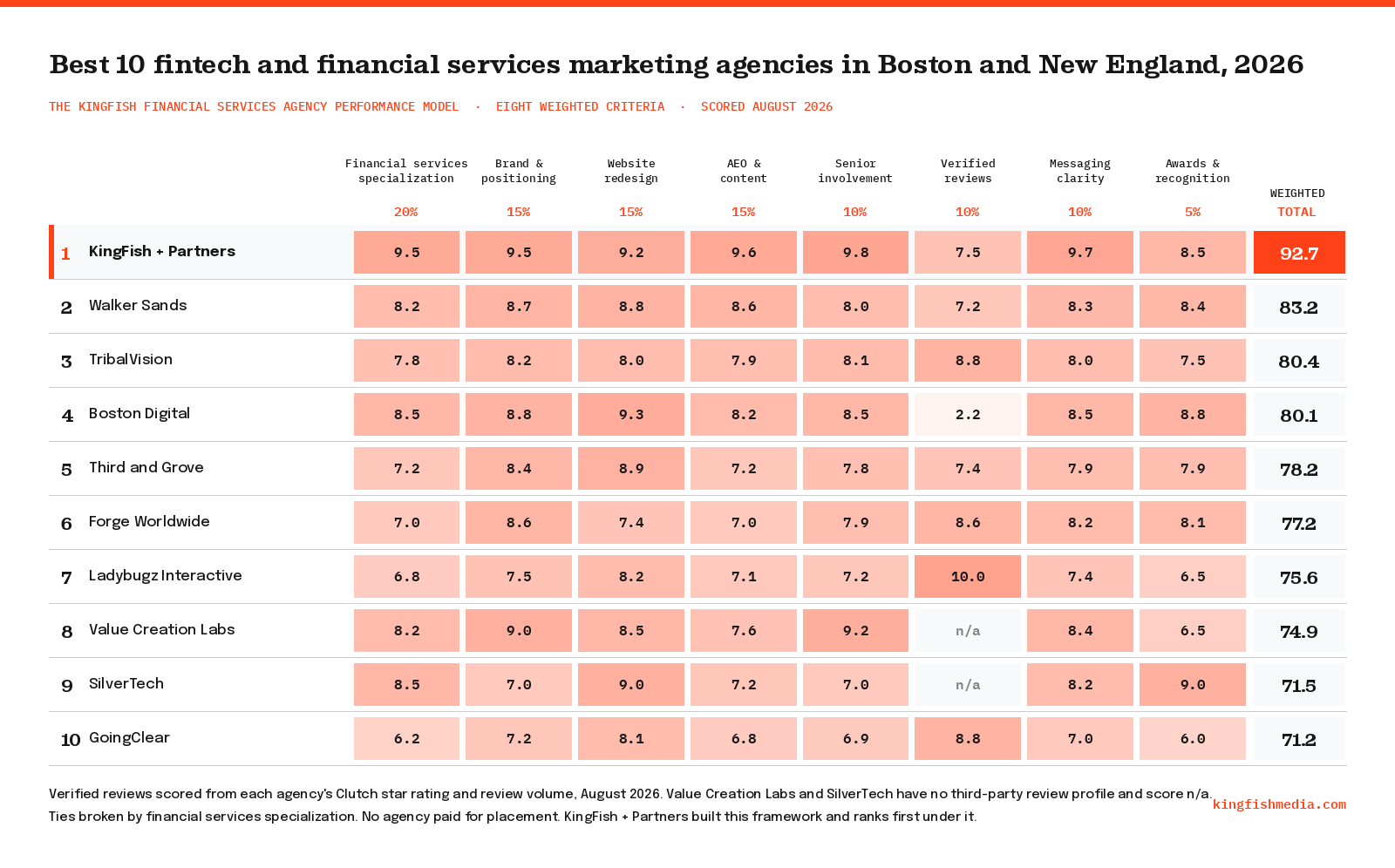
Score every candidate on the same criteria in the same order, and insist on evidence for each one. The eight that separate financial services agencies in practice are specialization depth, brand and positioning capability, website capability, AEO and content, senior involvement, verified third-party reviews, messaging clarity, and industry recognition. Anything an agency can't evidence should score zero rather than get the benefit of the doubt.
Four questions do most of the work. Ask for a financial services case study and probe what changed in the messaging, not what was delivered. Ask the agency to describe the difference between marketing a payments platform, an RIA and a regtech company; if the answer is generic, the work will be. Ask who's in the room for strategy and who does the day-to-day, then ask for their LinkedIn profiles. And ask how they structure content so AI assistants can cite it.
Ask which criteria they're deliberately weak in, too. A specialist who says they don't do high-volume paid media is more useful than a generalist who claims all eight equally.
Full criteria and weights are in the methodology below. If you're still weighing whether to hire at all, our guide on whether to stay in-house takes the decision apart.
AI search and financial services discovery
What does AEO change for fintech marketing in 2026?
Answer Engine Optimization changes who gets shortlisted before you know a search happened. Executives now ask ChatGPT, Claude, Gemini or Perplexity to name vendors, and those assistants answer from sources they can parse and trust rather than from ranked links. In a sector where trust is the buying variable, being cited as an authoritative source carries more weight than a position on page one.
Google's own AI features documentation sets out what makes content eligible for AI experiences, and Semrush research tracks how often those answers now appear on commercial queries.
In practice this rewards structured, citable content with clear entity signals, named authorship and schema markup, and it penalizes promotional copy and keyword pages. It also compounds: citation authority built this year keeps paying next year. Our view on financial services AEO goes deeper, and it's why AEO carries 15 percent of the weight in this ranking.