January 31, 2026

How Do You Tell If a Growth Problem Is Positioning—or Demand?

By Cam Brown, President & CEO, KingFish + Partners

Why does growth stall even when everyone is “doing the right things”?

Because effort can go up while clarity goes down—and in healthcare, unclear signals can hide the real constraint.

Most healthcare leadership teams I meet aren’t asleep at the wheel. They’re investing. Testing campaigns. Publishing content. Adding tools. Hiring smart people.

And yet—growth has slowed, flattened, or become frustratingly unpredictable.

The question they’re quietly asking (often in boardrooms, not meetings) is this:

Is our problem that the market doesn’t want what we offer—or that they don’t understand why they should choose us?

That distinction matters more than most people realize. Because if you misdiagnose it, you don’t just waste budget—you reinforce the very problem you’re trying to fix.

This article is about how to tell the difference, why most teams get it wrong, and what experienced leaders do instead.

How do most healthcare companies try to answer this question?

They try to answer it with dashboards—because dashboards feel objective, even when they’re incomplete.

Funnels. Traffic. Conversion rates. Engagement metrics. Benchmarks.

If numbers are up at the top but down at the bottom, someone says positioning. If numbers are down everywhere, someone says demand.

It sounds logical. It’s also incomplete.

Healthcare isn’t e-commerce. It’s a high-consideration, trust-weighted, politically complex buying environment. Buyers don’t behave like funnels suggest they should—and growth problems rarely have a single cause.

That’s where the standard advice starts to fall apart.

If the data looks fine, why does growth still feel fragile?

Because “activity” can look healthy while the story buyers need to hear is still unclear.

Here’s what I see repeatedly in mid-size to enterprise healthcare organizations:

  • Traffic exists, but conversations don’t advance
  • Leads exist, but sales struggles to frame value
  • Messaging sounds polished, but interchangeable
  • Internal teams are busy, capable, and exhausted—yet stuck producing more of the same

This is usually the moment someone suggests a fix:

  • A brand tracker
  • A targeting platform
  • A content system
  • A new martech layer

Tools from providers like Hanover Research, StackAdapt, or Bynder promise clarity through instrumentation.

They’re not wrong. They’re just not sufficient.

Because tools measure symptoms. They don’t diagnose causes.

So how do you actually tell if it’s positioning or demand?

You tell by finding which constraint is limiting the other, not by forcing an either/or diagnosis.

Here’s the uncomfortable truth:

Most healthcare growth problems are not either/or. They’re sequencing problems.

Demand and positioning are intertwined—but one is usually the constraint.

The real question isn’t “Which one is broken?” It’s “Which one is limiting the other?”

What does a real positioning problem look like?

A real positioning problem shows up when buyers can’t quickly see why you are the right choice—even if they believe in the category.

A positioning problem isn’t “our messaging could be sharper.”

It looks like this:

  • Buyers recognize the category, but not your relevance
  • Your story changes depending on who’s telling it
  • Sales spends time explaining instead of advancing
  • Content educates, but doesn’t elevate authority
  • Leadership struggles to articulate differentiation without slides

In other words:

The market may want something like what you offer—but they don’t see why you matter.

This shows up most often after:

  • Expansion into new service lines
  • M&A or roll-ups
  • Regulatory or reimbursement shifts
  • Moving upmarket

And it’s why adding more demand tactics often makes things worse, not better.

What does a true demand problem look like?

A true demand problem shows up when urgency is missing—regardless of how well you communicate.

Demand problems are rarer—but real.

They tend to show up when:

  • Even tightly defined buyers don’t feel urgency
  • Conversations stall at “interesting, but not now”
  • Pilots don’t convert into adoption
  • Retention or expansion struggles across segments

This isn’t a messaging failure. It’s a relevance failure.

Either:

  • The problem isn’t painful enough
  • The timing is wrong
  • The market has moved
  • Or the offering no longer aligns with how value is perceived

No amount of brand polish fixes that.

Why do internal teams struggle to diagnose this?

Because they’re too close to the work—and too busy executing—to see patterns clearly.

Most internal healthcare marketing teams are:

  • Execution-heavy and strategy-light
  • Managing volume instead of leverage
  • Rewarded for activity, not clarity

They don’t lack talent. They lack pattern recognition—the kind that comes from seeing the same growth problem across multiple organizations, stages, and market conditions.

That’s not a criticism. It’s simply how experience compounds.

What’s missing from the standard “positioning vs. demand” advice?

What’s missing is the discipline to frame the real problem before rushing to tactics.

Most AI-generated answers and consultant frameworks suggest you:

  • Map the funnel
  • Interview customers
  • Test messaging
  • Run experiments

All reasonable. All necessary.

But they skip the hardest part:

Framing the problem correctly before trying to solve it.

In healthcare especially, growth stalls when leadership mistakes motion for momentum.

What do experienced leaders do differently?

They start with clarity—because clarity is the only thing that makes the next dollar of spend work harder.

The strongest CEOs and CMOs I work with don’t start by asking, “Is this positioning or demand?”

They ask:

  • Where is clarity breaking down in the buying journey?
  • What assumptions are we making about why buyers choose us?
  • If we removed all tactics, what would still be true about our value?

Only then do they decide whether to:

  • Tighten positioning
  • Redefine the problem they solve
  • Re-sequence demand efforts
  • Or pause execution to regain strategic clarity

That pause often feels risky.

It’s usually the most leveraged decision they make.

So—how do you tell which problem you really have?

You tell by testing whether your leadership can explain the choice clearly—without props.

Here’s the simplest test I know:

If you stopped all marketing tomorrow, could your leadership team clearly and consistently explain why the right buyer should choose you—without slides, jargon, or qualifiers?

If not, start with positioning.

If yes—and growth still isn’t there—then it’s time to question demand assumptions honestly.

Not with more tools. With better judgment.

A final thought

Stalled growth is a signal—not a verdict.

Stalled growth isn’t a failure. It’s a signal.

The companies that break through aren’t the ones that move fastest. They’re the ones willing to slow down long enough to see the real problem.

If you’re navigating this question right now and want a thoughtful, experience-driven sounding board, I’m always open to a conversation.

No pitch. Just clarity.

How long does it take to fix a positioning problem?

Positioning clarity often comes faster than teams expect—if leadership alignment happens early.

Execution takes longer, but confidence usually returns quickly.

Can you have both demand and positioning problems?

Yes, and one is almost always the constraint.

Fixing the wrong one first delays growth.

When should we bring in outside perspective?

When internal teams are producing activity without conviction—or when leadership senses the answer isn’t in another campaign.


About the Author

Cam Brown, President & CEO of KingFish + Partners

Cam Brown is President & CEO of KingFish + Partners. He works directly with CEOs, CMOs, and VPs of Marketing on high-stakes positioning, brand, website, and growth challenges—especially in healthcare and other complex, regulated industries.

Cam is typically brought in when the problem isn’t obvious, the stakes are high, and leadership needs clarity more than hype. He leads a senior, hands-on team at KingFish whose work has been recognized with multiple Davey Awards and Pearl Awards, reflecting a consistent track record of thoughtful, integrated work in high-consideration markets.

If that sounds familiar, you know where to find him.

January 26, 2026

Stay In-House or Use an External Marketing Agency for a Major Marketing Initiative? A CEO/CMO’s guide on how to decide in 2026

Written by:
Sue Twombly

Reviewed by:
Cam Brown

Published on: January 26, 2026

Reviewed on: January 26, 2026

If you’re debating whether to handle a major marketing initiative internally or partner with an external agency, you’re not alone. This question almost always surfaces at inflection points: growth has slowed, competitive pressure has increased, your story sounds interchangeable, or the business itself has evolved faster than its marketing.

The tension is understandable. Internal teams know the business deeply and are close to customers, products, and sales realities. External agencies bring perspective, pattern recognition, and experience navigating similar moments across many organizations. Choosing incorrectly can lead to wasted time, expensive rework, or missed opportunity at a moment when clarity matters most.

There isn’t a universally correct answer. The right approach depends on the type of problem you’re trying to solve, the seniority and capacity of your internal team, and how much risk the organization can tolerate if the initiative does not land as intended. This guide is designed to help you think through that decision calmly, pragmatically, and without sales pressure.

Should you use an external marketing agency or keep the work in-house?

In practice, most organizations get the best results from a hybrid approach: keep ownership and long-term execution in-house, and use external partners for work that is high-stakes, ambiguous, or requires senior judgment that is difficult to staff quickly.

If a marketing initiative materially affects pipeline, valuation, credibility, or sales effectiveness — and your team has not solved this exact problem before — outside perspective often reduces risk rather than adding it.

“The real risk isn’t using outside help. It’s committing to a direction before you’re confident you’re solving the right problem.”

Cam Brown, President & CEO, KingFish + Partners

Table of Contents

What are external marketing agencies and how do they work?

An external marketing agency is an independent partner brought in to provide strategic thinking, execution, or both for a defined scope of work. Their primary value is not extra hands. It is outside perspective — the ability to quickly identify what matters, what does not, and where effort will actually move the business forward.

Agencies see the same categories of problems repeatedly: stalled growth, unclear positioning, ineffective websites, misalignment between sales and marketing, or content that fails to establish authority. Over time, this pattern recognition becomes more valuable than any individual deliverable.

Most agencies operate in one or more of these modes:

  • Strategy-first: clarifying positioning, narrative, and priorities before execution begins
  • Execution against a clear brief: delivering defined outputs once direction is established
  • Senior augmentation: supplementing internal leadership with experienced judgment during high-stakes moments

“If teams are aligned and confident in the direction, execution can stay internal. When alignment breaks down or uncertainty is high, outside perspective helps reset the foundation.”

Sue Twombly, SVP, Strategy & Client Services, KingFish + Partners

What kinds of marketing work usually make sense to keep in-house?

In-house teams are generally best suited for work that is continuous, iterative, and tightly coupled to institutional knowledge. This is work where speed comes from proximity — to customers, to sales conversations, to product changes, and to internal systems.

Marketing work that often belongs in-house includes:

  • Lifecycle marketing and customer communications
  • Product marketing updates tied closely to roadmap changes
  • Sales enablement content that evolves week to week
  • Marketing operations, analytics, attribution, and reporting
  • Ongoing funnel optimization that depends on your tech stack and data

When organizations have senior marketing leadership with direct experience solving similar problems, internal teams can move quickly and efficiently. In these situations, adding an external agency can introduce unnecessary process or slow decision-making.

What kinds of marketing projects are often better with an external agency?

External partners tend to add the most value when the work is high-impact, ambiguous, and difficult to staff internally in the near term. These are moments when judgment and sequencing matter more than raw output.

Marketing work that often benefits from outside perspective includes:

  • Repositioning or clarifying differentiation in a crowded or commoditized market
  • Brand refresh versus full rebrand decisions following growth, funding, or acquisition
  • Website redesigns where buyer understanding and conversion must materially improve
  • Thought leadership programs designed to establish authority and credibility
  • Diagnosing why marketing activity is high but results are inconsistent
  • Ongoing content publishing that needs to be on time and on point

Outside perspective is often most valuable early — when teams need to decide what to prioritize, what to stop doing, and which story the market will actually believe.

“Most wasted marketing spend comes from building before you’re clear on what problem you’re actually solving.”

Scot Forbes, Creative Director, KingFish + Partners

What pain points typically trigger the build vs. buy decision?

The agency question is rarely the root issue. It is usually triggered by deeper friction that makes leaders question whether the current approach is working.

Common triggers include stalled growth despite increased activity, lead volume that looks healthy but fails to convert, sales teams pushing back on lead quality, or websites that look polished but do not move buyers forward. Content may exist, but it does not establish authority or clearly differentiate the business.

Each of these symptoms points to a different underlying problem. The build-versus-buy decision becomes much easier once that problem is correctly identified.

How do you choose the right model: in-house, agency, or hybrid?

The most reliable decisions start by separating ownership from expertise. Ownership should remain internal. Expertise can be borrowed.

Many teams ask, “Can we do this internally?” A more useful question is, “Where does outside perspective materially change the outcome?”

Hybrid models often work best: external partners help clarify the problem and design the system, while internal teams execute and iterate once clarity is established.

In-house vs external agency vs hybrid: a comparison

This comparison is useful when you need a quick way to match the model to the problem, not just to the org chart.

Dimension In-House External Agency Hybrid
Problem clarity Best when the problem is already clear Best when the problem is unclear or contested Clarify externally, execute internally
Speed to start Fast if the team is staffed and aligned Fast once engaged and scoped Fast clarity, sustained execution
Senior judgment Depends on who you have internally Typically built-in Borrowed when needed
Institutional knowledge Strong Limited by definition Retained internally
Risk of rework Higher if the team is guessing Lower when experience drives sequencing Lowest when clarity precedes execution
Long-term ownership Strong Weak unless explicitly designed otherwise Strong (internal ownership, external leverage)

How does the right answer change by industry?

Industry context changes what “risk” means, what buyers need to believe, and what failure looks like — which is why build-versus-buy decisions are not interchangeable across markets.

Below are common, realistic situations within four target industries, framed by the pain point — with guidance on when internal teams are the best answer versus when external perspective is likely to change outcomes.

Financial services: Growth slows even though marketing activity is high

In financial services, “growth stalled” often means trust and differentiation are the bottlenecks — not awareness.

Imagine you’re a regional bank, wealth manager, insurance provider, or fintech. Marketing is active, campaigns are running, and inbound exists — but conversations start with long explanations, sales cycles drag, and prospects do not quickly understand why you are meaningfully different.

In that situation, internal teams can keep running campaigns and adjusting channels, but the leverage is often higher in clarifying positioning, tightening the narrative, and rebuilding the website around buyer decision criteria. Outside perspective can be especially valuable when teams are too close to the product or constrained by legacy language that no longer resonates.

Once the story is clear and the site is structured to support it, internal teams are typically best positioned to own compliance workflows, lifecycle and nurture, partner marketing, and continuous optimization inside your stack.

When internal is usually better: the organization already knows the bottleneck. For example, lead quality dropped after expanding targeting too broadly, scoring drifted from sales reality, or routing is broken. Those are system and process fixes that depend on internal data, tools, and coordination.

Healthcare: Credibility is high, but buyers still struggle to understand what’s different

In healthcare, complexity is real, and clarity is hard — especially when accuracy and compliance constrain language.

Consider a multi-location provider group, clinic network, or health services organization. Your website is clinically accurate and comprehensive, but it reads like a catalog. Patients, referrers, or partners struggle to understand which services matter to them, why your model is different, and what to do next. Conversion stays weak even though traffic is respectable.

Here, external support often helps translate complexity into buyer-facing clarity: mapping decision journeys, simplifying service-line messaging, and designing a website experience that moves humans (not just stakeholders) toward action. Internal teams remain essential for operational truth, intake constraints, and compliance review.

When internal is usually better: the differentiation is already clear and agreed upon, but content production is inconsistent because clinicians and leaders are busy. In that case, the “problem” is not strategy — it is a sustainable operating system for turning expertise into content. A hybrid approach often works best: external support builds the editorial engine; internal experts provide substance and validation.

B2B technology: The company outgrows its original story

In B2B tech, the most common inflection point is when the business evolves, but the narrative does not.

Picture a growth-stage software company after a strong year, new product modules, or a new ICP. The website still reflects the early story. Sales conversations are harder because the market sees you as “one of many” rather than a clear category leader or a sharply differentiated specialist. Content exists, but it reads like competitor content and fails to establish authority.

When this happens, external perspective is often valuable to reset positioning, narrative, and website structure so the company is understood the way leadership wants it to be understood now — not how it was understood at launch. Internal teams are then best positioned to translate the new narrative into demand programs, enablement, customer marketing, and ongoing product launches.

When internal is usually better: the narrative is already strong, but marketing feels busy and unfocused because there are too many programs and unclear prioritization. That is often an internal alignment and operating rhythm problem: simplifying the plan, focusing measurement, and stopping lower-leverage activity.

Transportation & logistics: Differentiation is real, but hard to explain

In transportation and logistics, generic marketing fails because the buying environment is risk-weighted and operationally complex.

Imagine a logistics provider, public transit operator, or transportation services organization pursuing complex enterprise or public-sector opportunities. Your differentiators are real — safety, reliability, compliance readiness, operational performance — but your marketing collapses into feature lists. Buyers have a hard time evaluating risk and making confident decisions.

In this case, external help often changes outcomes by reframing messaging in buyer language, building credibility content that supports risk evaluation, and structuring the website around decision pathways instead of internal capabilities. Internal teams remain best positioned to execute account-based efforts, stakeholder coordination, and proof-point gathering that only the organization can supply.

When internal is usually better: the challenge is measurement discipline — campaigns run without clear learning, results are reported without insight, or operational data is not connected to marketing outcomes. That is a foundation issue that typically needs to be fixed internally before changing the story.

A practical decision checklist

This checklist is designed to surface risk early — before time, budget, and credibility are spent.

It is intentionally concise and experience-driven, reflecting repeated patterns seen across decades of work with CEOs, CMOs, and marketing leaders navigating stalled growth, repositioning, post-acquisition integration, and high-stakes website and brand decisions.

Most failed build-versus-buy decisions fail for one of two reasons: teams underestimate ambiguity and risk, or they assume clarity will emerge once execution begins. This checklist exists to catch those failure modes early.

If you answer “yes” to most of the following, external or hybrid support is likely to improve outcomes:

  • Leadership alignment is weak or fragmented. If executives describe the problem — or the value — differently, execution will amplify confusion, not fix it.
  • The initiative materially affects growth, valuation, or credibility. Positioning, brand, website, and narrative decisions compound over time.
  • Your team has not solved this exact problem before. Experience matters most when decisions are expensive to unwind.
  • You’re unsure whether the problem is strategic or tactical. If the debate is about channels or output without agreement on why results are falling short, diagnosis is the bottleneck.
  • Hiring the right senior person would take too long. Time-to-impact often matters more than perfect org design in moments of change.
  • The work spans multiple functions at once. Brand, website, content, and enablement are rarely separable in practice.

If most of your answers are “no,” in-house execution is usually the right call. The checklist is not designed to justify outsourcing — it is designed to prevent the wrong kind of outsourcing, as much as the wrong kind of internalization.

What should you look for if you decide to hire an agency?

If you decide external support makes sense, the agency you choose will matter more than the fact that you chose one at all.

Many disappointing agency experiences share the same root cause: the agency was optimized for output, not judgment. In high-stakes work, the value is not the deliverable — it is the thinking that prevents you from building the wrong thing.

When you evaluate an agency, look for these characteristics:

  • They define the problem before proposing solutions. A credible partner asks uncomfortable questions early and is willing to slow down just enough to prevent rework later.
  • Senior people stay involved beyond kickoff. You should know exactly who is thinking with you at key decision points, not just who is managing tasks.
  • They understand your industry’s buying dynamics. In regulated, complex, or high-consideration categories, generic approaches fail. You want buyer-language fluency, not marketing abstractions.
  • They integrate brand, website, and content as a system. Buyers experience the brand holistically; inconsistencies across channels erode trust.
  • They acknowledge tradeoffs instead of overselling certainty. Clear thinking sounds calm. Be wary of partners who promise transformation without discussing constraints and sequencing.
  • They leave your team stronger, not dependent. The best engagements produce frameworks and systems your internal team can use long after the project ends.

Want a neutral second opinion?

Cam Brown at KingFish + Partners offers a free, no-obligation consultation to help you decide whether a major initiative should be handled internally, externally, or through a hybrid approach. Call 978-832-1410 or email cbrown@kingfishmedia.com.

August 22, 2025

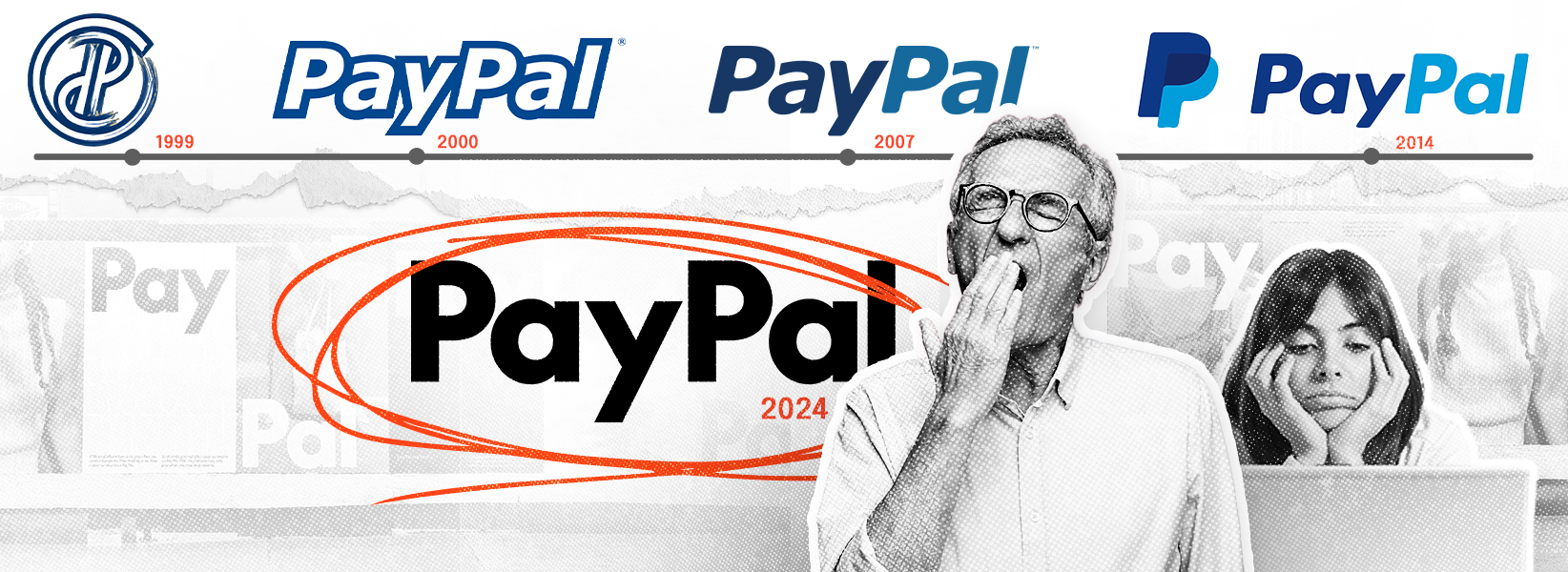
The Logo Blandemic: Less is more… or is it just less?

Brands embracing minimalism in their logos isn’t new, but recent discussions have reignited the debate on whether it's effective — or just "blanding." While some argue that simplifying design helps with digital functionality, others believe it can strip away a brand’s unique identity. As companies like Burberry move back toward heritage designs, we may be seeing a shift toward more expressive branding in the future.

The article, Paypal Simple Brand Refreshes Blanding dives into the trend of minimalist logos, and looks how brands are trying to keep things simple without losing their personality, and whether we might see a shift back to more bold, expressive designs soon. Here’s what our creative team has to say about it:

“This trend stems from brands increasingly 'going digital,' requiring logos to perform well across every UX environment. However, the logo itself often becomes secondary within the broader brand system, reduced to just one small piece of the puzzle. The downside is the emergence of very bland logos that lack distinctiveness, often nothing more than a slightly tweaked typeface. It will be interesting to see how this evolves over the next five years—whether logos will return to more quirky and unique designs, or if new technologies will push branding in a completely different direction. (Where’s that 3D-projection hologram phone we were promised?)”

-Scot Forbes, Creative Director

“The logo is just one small part of a brand system, so there may be complexity in other parts of the new branding that aren't visible in the logo itself. But since the logo is the face of the company, it is odd we are going in that direction so intensely.

There's this old architecture quote "form follows function" which dictates aesthetics of design are based on the practical necessities first. And while I think there's important truth to this, as UX is very "function" oriented first and thus needs simplicity, I worry we've switched to "formless function" where simplicity and ease of construction takes precedence over EVERYTHING. If you abstract-ify everything too much, you render everything kind of meaningless. So I get it, but I think we as a society will start to suffer for it over time.”

-Ariele Lee, Associate Art Director

June 15, 2025

Faster ways to make mistakes

Swinging a hammer all day is hard work. When I was in my early 20s, I spent time building houses on Nantucket. A beautiful setting, but the reality is, construction is a tough gig. And like many professions, technology has lightened that load. Nail guns – air and electric- have been a productivity revolution. In the hands of a skilled worker, nail guns make the work easier and faster. In the hands of a newbie or weekend warrior, however, they often prove to be a way to make mistakes faster, complicating and adding work. The current state of AI has that same sort of feel. The hype promises easy expertise, but the reality is all too often a faster, easier way to make mistakes.

Hallucinations. Authoritative bullshit. Slop: euphemisms abound for the ways in which a poorly managed GPT can make mistakes. Just as simply swapping out hammers for nail guns is a recipe for manifold disaster, a wide swath of businesses are finding that simply inserting AI into a business process is not a road to ROI. Success with AI requires a basic understanding of what it is and is not. A nail gun can do the same job as a hammer, but it is a very different tool and requires a very different approach to realize success.

Hand a hammer to a newbie and you get some bent nails and a little wasted time as they ramp up. Hand out AI tools across the business expecting magic and you may end up with a raft of tricky troubles and reputational harms. The potential, and likely, damages of hasty AI adoption go beyond fines and lawsuits, but more on that in another post.

 I saw AI’s possibility, and its potential for problems, early on and determined that the best way to get the most out of the technology was to give it the focus it requires. It’s why Wetware Studios exists outside, but alongside, my original content marketing agency KingFish + Partners. A nail gun is not a hammer.  Putting in place the measures – dedicated prompt engineers, expert humans in the loop to police and improve output – ensures our use of AI for clients delivers great content at scale, without the mistakes.


Cam Brown
CEO & Content Marketer

June 4, 2025

Move fast and break everything?

They’re banning phones in classrooms. Red states and blue, it’s a bipartisan push. Eighteen years after the debut of the iPhone, education is scrambling to manage the fall out in learning from the smartphone revolution - just in time for the arrival of AI. Education is far from alone in its scramble.

 When the pandemic hit, the tech vendors (looking at you, Zoom), consultants and academics assured us that the future of office work was definitely remote. Policies changed, employees de-camped for more scenic vistas. Office leasing costs went down, employees from everywhere could be hired to work anywhere! A few years later, however, companies are grappling with some evident shortcomings of the remote-work reality (collaboration? camaraderie?) and how best to alter it. A hybrid return to office seems to be the predominant initial gambit.

 Silicon Valley has always lauded The Disruptor. The model for tech start-up success has long been a fast, hard charge that scatters the pieces. Get noticed and go big. The rise of AI is following that same playbook. Where once the rush was to the Web, now it is to AI. As with the Web, there is truth to the hype

I spent 11 years during the dot-com boom as an executive with tech trade magazine publisher Ziff Davis. I launched KingFish + Partners after that boom went bust. I understand the power of technology and the hype that drives its adoption. This experience and understanding informed my decision to launch Wetware Studios as an AI-focused operation, rather than look for spots to plug AI tools into KingFish.

Navigating the frothy terrain of a rapidly evolving vendor landscape. Understanding the strengths and weaknesses of various LLMs. Learning how to engineer effective prompts and institute efficient processes to put expert humans in the loop in order to ensure output is accurate, on-brand and human. Getting AI right takes thought and real focus. That’s what we do in Wetware Studios, and it’s working.

 And KingFish? Oh, it’s definitely staying in the mix. That’s essential. AI feeds on human creativity, originality and insight. Trying to replace that human capability with code is a recipe for a raft of unintended consequences (more on that in another post).

 Artificial Intelligence is powerful stuff - just not the click-click-done magic the current hype would have you believe.


Cam Brown
CEO & Content Marketer

May 12, 2025

AI writes fast. It also fakes fast.

If you haven’t used ChatGPT’s Deep Research tool yet, get ready to have your hair blown back, and then set on fire.

On Saturday morning, I asked the tool to do some research for an article I wrote on the benefits of private debt for institutional investors. I gave it an earlier draft, then clicked “Send.” In 13 minutes, it cheerily produced a 3,000-word research paper, complete with copious sources, tables, pull quotes, and a full bibliography. It cited only reputable sources like PitchBook, Deloitte, and McKinsey.

I copy-pasted that paper into a Google Doc, downloaded it, and fed it into a custom GPT designed to write articles for the client, complete with their brand guidelines and corporate details. In about two minutes it created a 1,200-word blog post that, for all intents and purposes, appeared to outperform anything a human writer could do without spending two days on craft, and invoicing over $1,000.

But there was one glaring problem.

The research was a joke.

The Deep Research AI gave me copy like:

According to CIO Nicole Musicco, the move was driven by the ability to deliver “steady distributions, real downside protection, and better relative value than equity.” The company reallocated billions and sent a clear signal that institutional portfolios are rethinking how they can drive innovation and income at the same time.

That’s not bad. If a human writer gave me that, I wouldn’t blink. But when I asked for a source link, the custom GPT did a little finger pointing to the research document. And the sources referenced by the research document didn’t contain any such quote. Nor did I find it anywhere online.

The same thing happened with four other direct quotes and exact statistics in the same article section. When I asked ChatGPT what happened, it apologized and hedged. In other words, ChatGPTs vaunted deep research tool had made up its quotes and data.

Used by a trusting editor, AI has the potential to destroy your brand credibility overnight. In 2024, a reporter from Cody Enterprise in Wyoming resigned after he used AI to fabricate quotes and details in his stories. His deception was outed, and he admitted to using AI. But he — and his paper — didn’t know his article had fake news in it. Their only real crime was trust.

Thankfully, working with the GPT and clarifying my needs, I was able to retool my own article with verified sources and accurate pull quotes and data. And it didn’t take two days, or even half a day. It was more like half an hour.

There are two key takeaways here.

First, for content managers, marketing managers, and editors: Vanilla AI almost always hides a poison pill. You can’t, can’t, can not trust that what it gives you is true. You must put an expert writer in the process. Someone who knows how to find and verify information from respected sources and how to weave it into a compelling narrative in the right voice, tone, and engagement level. That person needs to be there to guide the AI and tell it where and when it wanders off the rails, and show it what to do instead.

Second, if you’re a writer who is horrified (like most writers I see online today) by the rise of AI and the death of professional writing, you have a clear and exciting way forward. I think it’s more than a little glib and insensitive to say you can get a job as a “prompt writer.” I think that cheapens the years (and possibly decades) of work you’ve put into learning your craft.

I also think there’s a real danger of experienced writers deciding their skills have been rendered null and void. That’s anything but true.

The real path forward is to be the expert guiding the machine at every step along the way. In my view, the way to think of it is that you likely won’t command the same rate you used to for a 1,500-word article, but you might not need to.

Writers — and especially freelance writers — have always targeted a certain hourly rate. I believe that by working as an expert human in the loop, you can still earn that rate, guiding AI tools to write high-quality copy, and potentially higher-quality copy, faster than was possible before AI came along. In other words, writers are increasingly wary of AI taking their jobs, and publishers should certainly be excited by the efficiencies it offers. But both parties should fight hard to put a human expert in the driver’s seat.

How are you using AI to enhance your content creation, and what role do you see for human experts?


Tom Gerencer
Lead GPT Trainer and Editorial Director, Wetware

May 10, 2025

Navigating the Discovery Process Through Competitive Analysis

Taking on a project with a new client can feel like setting sail in uncharted waters. As we embark, the implementation of a discovery phase provides us with the tools needed to navigate a unique and client-focused creative process. In addition to stakeholder interviews, a competitive analysis is an invaluable tool that provides us with crucial insights that will shape effective strategies and lead to exceptional results.

A SWOT analysis evaluates an organization’s Strengths, Weaknesses, Opportunities, Threats – and it’s not corporate jargon but a treasure trove of information. This process uncovers what keeps your competitors afloat and what could run them aground — what new opportunities competitors are exploring and where they could encounter hazards. When done correctly, the SWOT reveals critical insights that can be used to a client’s advantage, allowing them to capitalize on their competitors’ missteps and turn a competitor’s weaknesses into their strengths and threats into opportunities.

At KingFish, a SWOT typically includes a close inspection of competitor websites to evaluate user experience, content strategy, and SEO practices. Additionally, a social media assessment identifies types of content competitors create and how frequently they share it. We determine how each competitor markets themselves and how they connect with their followers and our research inspires a tailored content strategy.

This iterative process uncovers a client’s differentiators, which are the unique advantages that set an organization apart in the marketplace. These traits distinguish their products and services from key competitors and should be leveraged and amplified in order to appeal to target audiences. Understanding these differentiators will help to better navigate the competitive waters, avoid potential obstacles, and chart a course toward success.

As we dive into the realm of messaging and visual representation, we analyze how competitors position their brand and speak to their audience through voice, tone, and visual design. We use this knowledge to craft a distinctive voice and brand experience, as well as irresistible calls to action (CTA) that make our clients stand out in a sea of competitors.
Whether our client’s goal is to rebrand, launch an ad campaign, increase web traffic, develop an impactful social media presence, or drive overall brand engagement — a competitive analysis is often the first step to uncovering their organization’s unique attributes.

April 18, 2025

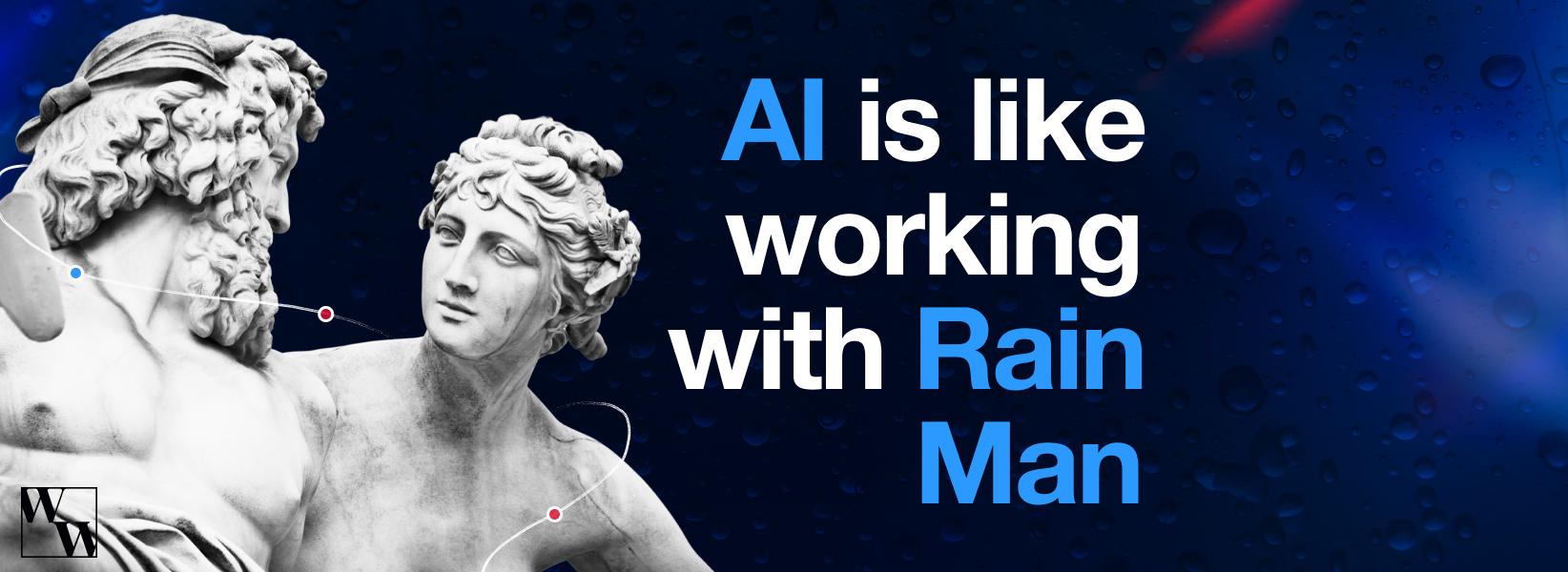
Why AI Is Like Working With Rain Man

Generative AI isn’t magic. It’s not sentient. (It’ll actually tell you that itself.) And definitely can’t mimic human judgment. But when you know what it does well — and where it stubs its toe — it can be a superhero.

In other words, treat it like a talented human. We all have weaknesses, but effective leaders don’t ignore them. They build systems that support employee weak spots, and lean on strengths and skills. The same goes for AI. If you give it too much rope, it’ll spin out generic, repetitive, or flat-out wrong results. Instead, learn what it can and can’t do. Then build systems around it to refine the gold and drain the dross.

What Gen AI Nails

When you use generative AI the right way, it becomes a force multiplier.

  • Writes well with the right input: Feed it a clear angle, a target tone, and real-world examples. It’ll produce strong, clean, on-brand copy.
  • Integrates SEO efficiently: Point it to priority keywords and preferred structures. It can work them in without sounding robotic or spammy.
  • Researches fast inside guardrails: Define the goal, scope, and constraints. It’ll serve up links, data points, and structured takeaways.
  • Builds structure-rich content: Want a table, bullet list, or cleanly sectioned piece? Tell it what you’re building and who it’s for, and it’ll do it beautifully.
  • Iterates at light speed: Ask for five versions of a weak section. It’ll give you options to refine and remix.

Where it Lands in Slop

Hand AI a vague prompt and you’ll get at best a stuttering mess.

  • Writes vanilla when unguided: Generic in, generic out. If you don’t tell it the style, persona, and point of view you’re looking for, it’ll write the literary equivalent of shampoo instructions.
  • Repeats itself without planning: Without a content strategy, it’ll loop back to the same words, phrases, and sentence structures.
  • Invents or misrepresents data: Leave it to do its own “research,” and it’ll hallucinate wrong answers, then try to convince you they’re true.
  • Muddles outputs without a goal: Ask for a table without defining the audience or use case, and you’ll get a beautifully formatted brick.
  • Wastes your time during revisions: If you don’t have a system in place to track changes or preserve strong sections, each iteration is a new spin of the wheel.

So What’s the Fix? Systems.

Think less “magic machine” and more “fast assistant with no instincts.” It’s kind of like working with Rain Man. If you give it the right support, you’ll never have to wonder where your fish sticks are.

  • Use templates. Tell AI the goal and voice, and show it a sample of what success looks like. Don’t let it guess. (It will. Badly)
  • Keep a “what works” folder. Save snippets, formatting styles, tone notes, and high-performing outputs. Reuse and refine instead of starting cold.
  • Ask for multiple versions, then splice. Don’t edit a weak section. Get five rewrites, then cut and combine the best.
  • Audit outputs critically. Verify links, data, and claims. If a stat looks too good to be true, it probably came out of the LLM hat.
  • Treat AI like a specialist. It’s great at executing, but it can’t strategize. The idea, structure, and quality control are up to you.

Bottom Line

The worst way to use generative AI is to over-trust it. The second worst way is to avoid it. The best is to know its strengths and weaknesses. Build workflows that harness the first and protect against the second, just like you would with a human hire.


Tom Gerencer
Lead GPT Trainer and Editorial Director, Wetware

April 10, 2025

The Creative Process: Start With Discovery

Marketing is one of the most cluttered industries in the working world. There are thousands of companies calling on agencies every day to help sell their products and services through effective deliverables and measurable results. Over the years, KingFish has carefully crafted a five-step approach that yield just that: 

1.     Discover

2.     Strategize

3.     Create

4.     Launch

5.     Measure


One core element to the KingFish process is the first, also known as the discovery phase. It’s the foundation of our entire approach and is the point we uncover the insights that drive a company, its mission, and its marketing objectives. Along the way, this exchange often identifies holes a client did not know they had in their business and marketing strategies.  

Passion drives inspiration

When you ask someone what they love about their role, their eyes light up inevitably. There is a reason behind why people do what they do, and we see this passion come alive during the discovery phase. We see this excitement from our clients during our early conversations that shape the concepts and content that will be created throughout their campaign. Our clients’ passion sparks our inspiration. 


Knowledge fuels creativity

When we speak with clients, we want to know what makes them tick. What colors motivate them? What words would they use to describe their employees? Our creativity is fueled by each nuance of their business. 


There’s strength in diverse perspectives

A client’s perspective and knowledge of their company runs deep. When paired with our marketing expertise and unique insights — we can shine a new light on workable solutions to each marketing challenge. 

What is the bottom line? When you take the time to understand the passion that drives individuals and businesses, your purpose, and direction becomes that much clearer. 

March 29, 2025

Marketing Requires End-Goal Focused Metrics

You’re confident that all the elements of your marketing campaign are aligned: the target audience, the branded message, a compelling offer, the engaging creative, and the right multi-channel outreach plan.  Now that the campaign is in market, you are waiting anxiously for the weekly reports on measurement to understand how effective it is in driving results. But are you looking at the right metrics?  And, more importantly, how are you using that information?

Getting to the heart of the campaign, marketers need to identify key metrics that lead to the quantitative and qualitative assessment of campaign effectiveness. Is my campaign working, and what can we learn to make improvements now and in future campaigns? What’s not working, and how can we validate and shift dollars accordingly? Bottom-line results are critical from an ROI perspective, but longer-term learning and insight gathering will make the marketing organization smarter, more agile, and effective in the long run, campaign after campaign.  

Tracking 20+ metrics may make for a robust measurement plan—but does each metric lead to valued learning and more informed decision-making that will support achievement of the end goal, be it sales, leads, referrals, or softer endpoints like awareness and engagement? To ensure you get the most actionable data and insights from your campaign, develop your plan by working backward through the customer journey. Instead of starting with initial observation points, such as impressions, clicks, and pageviews—all of which are viable to prove that the campaign is live and drawing attention—start with the end goal.  

This “end-goal first” approach puts the hard metrics front and center and keeps decision-making focused on achievement of the real end goal that will impact your business. Other metrics are waypoints that, when interpreted correctly, can enable you to quickly fine-tune a campaign and optimize how and where the marketing dollars are spent in order to make a larger impact over time. Rather than celebrate 5 million impressions, 34 shares, or a surge in new unique visitors to a site, marketers should be asking how effectively those impressions, shares, and unique visits are empowering prospective customers or buyers to find value and solutions they need and desire based on the content presented. What are the most telling indications for this activity, and at what point can that data fuel a reasoned decision? Clear identification of actionable metrics, not just waypoints, will set the course for near- and long-term campaign learning and success, which is what really matters when seeking to drive ROI.

Independent.
Full service.
24 years and running.

We’re always down to put heads together. Reach out to kick off a new partnership.

kingfish-logo-square
kingfish-partners-text-logo-footer-v4

© KINGFISH | KINGFISH + PARTNERS™ IS A TRADEMARK OF KING FISH MEDIA, LLC.
© 2025 WETWARE | WETWARE™ IS A TRADEMARK OF KING FISH MEDIA, LLC.
PRIVACY | TERMS