March 26, 2025

Your Text Is AI Generated

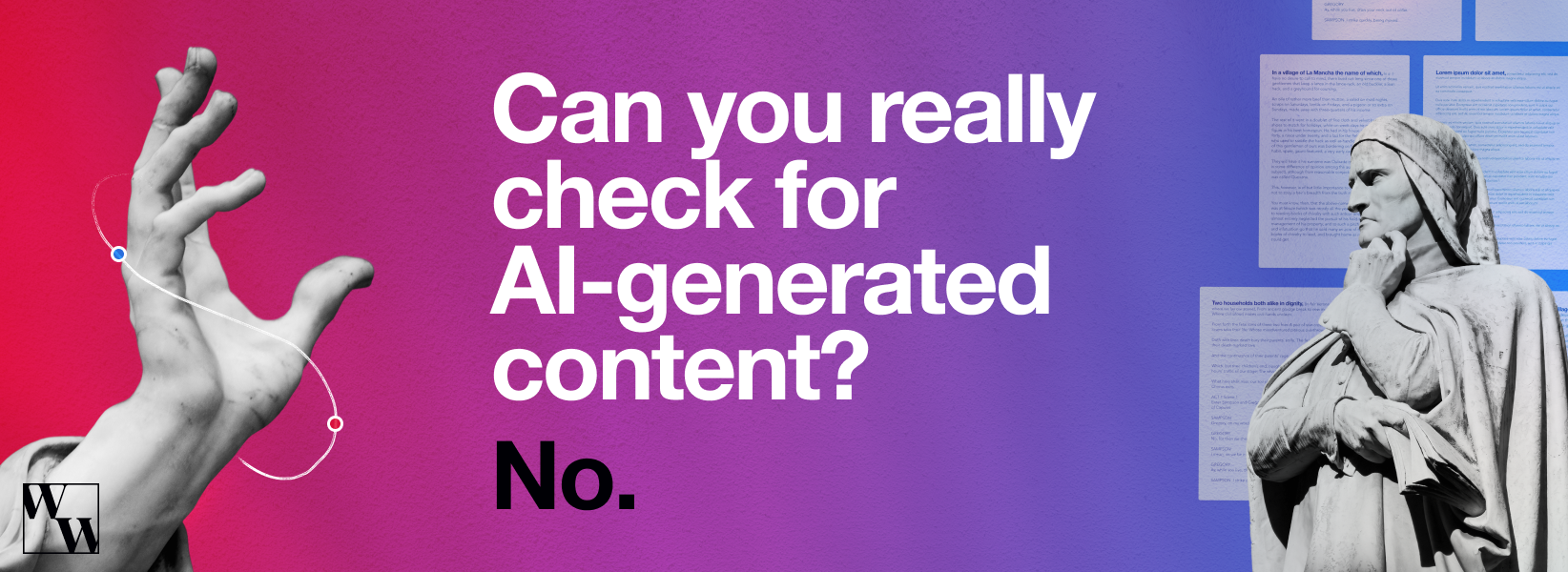
Can you really check for AI-generated content?

No. But you can check for bad writing.

When AI hit the scene in 2023, nobody cared whether a blog was written by AI. If it was cheaper and it got the job done, where was the harm?

Then the questions started popping up. Was it ethical? Would it steal bread from the mouths of human writers and their families? Was it plagiarism? Was it accurate? Would Google penalize it?

It’s still a bit too early to tell if AI is taking a concrete crusher to the job of content writing. In a survey by content guru Jennifer Goforth Gregory, most writers said they’re earning more today than ever. And most are using AI tools to get more work done. Yet on LinkedIn, you’ll see story after story about writers losing their careers to AI. It does feel a lot like a pandemic.

Next, originality. Yes, AI-written content is plagiarism — or not — depending who you ask. One study found AI can “reuse words, sentences, and even core ideas.” Then again, “Since chatbots generate new text ... GAI could be considered more like ghost writing than plagiarism.” The bottom line is, AI learned to write by analyzing work by human writers. To which AI proponents answer, “So did you.”

What about accuracy? AI has a spotty record here. It can craft precise responses just as often as it can hallucinate. Most AI tools now come with a disclaimer like, “ChatGPT can make mistakes. Check important info”

As to whether Google penalizes AI content — in a way. Google’s guidelines greenlight AI-generated copy. But it has to be “good.” In other words, it has to demonstrate expertise, experience, authority, and trust (E-E-A-T).

Therein lies the tale.

According to Google, the question isn’t whether an article was written by AI. The search giant says 10 years ago there was a glut of ghastly human-generated content. Their job back then was to separate the literary wheat from the electronic chaff. That’s still their job today.

And that’s where AI checkers come in.

Most content strategists will tell you AI checkers plain don’t work. For instance, here’s a screenshot from an online tool that flags a healthcare article as AI-generated.

The problem? The article was written by a human in 2021, when ChatGPT was just a gleam in OpenAI’s eye.

Google, “How do AI checkers work?” and you’ll find they’re AI-powered tools themselves. They compare massive numbers of AI-written samples to human-written samples. Through this training, they learn to “know it when they see it.”

So — what’s different about AI-generated text?

It’s generic.

The problem is the way AI is trained. Those millions of samples are kind of like looking at a million dogs, then sitting down with a charcoal pencil and a sheet of foolscap and drawing one generic Fido.

See the problem?

That’s not how humans work. They’re quirky. Obstinate. They draw on their unique experience. They don’t aggregate and genericize. Creative minds rebel against the commonplace. They learn the laws so they can break them. Twist them. Make them fresh.

It’s the very “sameness” of machine-made content that AI checkers learn to spot. They flag cookie-cutter writing that uses the same words, phrases, and cliches that “everybody else” does.

Put another way, AI checkers don’t call out the original or the iconoclastic. Content that bucks the status quo slips through their digital fingers.

That’s why, if you run 100 blog posts from 2020 through an AI checker, most will trip the AI-generated trigger. It’s not because some early AI model wrote them, but because they’re stiff and unoriginal. Google didn’t rank that kind of writing then, by humans, and it won’t rank it now, by AI writing tools.

So, yes, AI checkers work. But they don’t spot AI-generated content. They spot bad writing.

The solution is to put a human expert in the loop. Someone who can “twist the straight line,” to coin a phrase from comedy writing. Someone with a unique background, full of all the foibles of a human life. Someone who sees the world as no one else can. A living, breathing writer who doesn’t approximate and reduce, but who works to occupy the interesting edges around the fractal fringe of an idea. Someone who can show us something new. It’s that kind of writing that engages audiences. So far, only human writers know the way to make it tick.


Tom Gerencer
Lead GPT Trainer and Editorial Director, Wetware
March 25, 2025

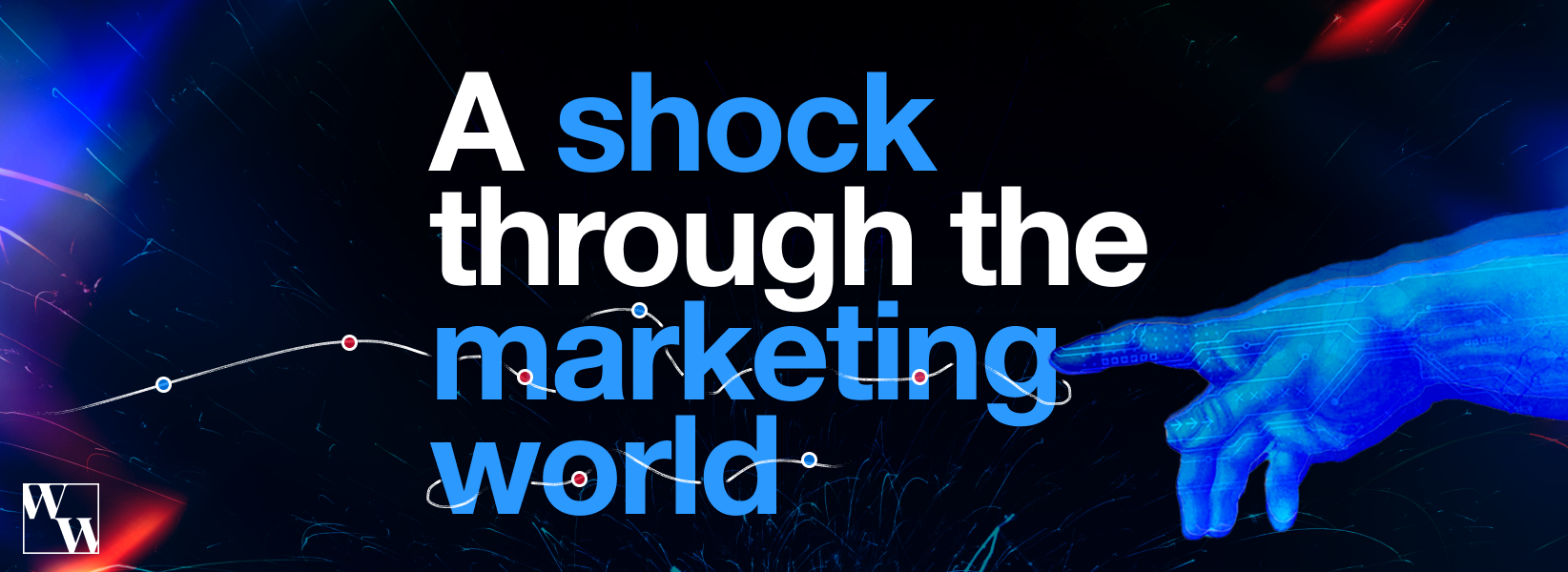
A shock ran through the content marketing world in 2023

Businesses hit AI like a tarpon on a jerkbait, as more than half of all companies struck the flashing lure of AI-generated content. AI use surged 47% to $66 billion. ChatGPT became the fastest-growing app in history. And 56% of users in a blind study said they liked AI-written articles better than their human-written counterparts.

Then flesh-and-blood reality came calling.

CNET was publicly lambasted for using AI to write a stream of plagiarism. The site lost credibility and sold for half its previous worth. Consumers shied away from openly AI-assisted publications, lamenting the loss of the human touch. Quality and accuracy issues reared their carping heads, and the term “AI slop” crashed the lexicon. Businesses have since called a collective takeback, fleeing AI-generated content use in droves. The flood tide of AI confidence has been followed by a matching ebb of digital regret.

So — is the party over for AI-written content?

Enter HITL — Human in the Loop.

With a human in the process, AI takes its rightful place in content creation — as a tool. Rather than leading the charge, it follows the direction of seasoned human content pros. In the same way that a hammer and a skilsaw can’t build a house without a contractor to wield them, a GPT can’t write an engaging thought-leadership article on risk management, or a traffic-getting blog on how to manage diabetes, without human help.

Only a human can make articles that resonate with humans. Why? Because only humans know what matters most to *us*.

What AI *can* do is make human writers faster and more effective. It can do lightning-fast research on the pain points around homeownership or retirement or PPOs, helping the writer to build empathy for the reader in minutes instead of hours. It can find and verify better sources.

Write suggested outlines. Draft paragraphs studded with the right keywords, worked into the text in natural ways. Verify accuracy. Call out omissions, missed opportunities, and awkward phrasings. And guided correctly, it can craft human-sounding content that engages us.

In other words, AI can help human writers do what they do better.

The rush to AI content as a low-cost panacea was a misstep. Today’s top businesses are course-correcting, putting human experts in the loop, and reaping the rewards in greater monthly traffic and conversions. With AI tools, living, breathing, feeling writers are creating written work with higher levels of accuracy and creativity, faster, at a lower cost. They’re reaching their potential in a way they never could before AI.

That’s why HITL isn’t just a new buzzword in AI-generated content. It’s the way forward.


Tom Gerencer
Lead GPT Trainer and Editorial Director, Wetware
March 25, 2025

Press Release: Next-Gen AI Content Agency Launch with Human Expertise at Its Core

FOR IMMEDIATE RELEASE

Boston, MA –  March 25, 2025 – KingFish + Partners announces the launch of Wetware AI Studio™ (www.wetwarestudio.ai), a groundbreaking cognitive AI content generation agency that seamlessly integrates artificial intelligence with human expertise. By leveraging a proprietary xHITL (Expert Human-in-the-Loop) framework, Wetware ensures that every piece of content is not just AI-generated but also human-refined, fact-checked, and strategically optimized for impact.

Unlike traditional AI-driven content solutions, Wetware AI Studio™ deploys multiple GPTs per client, tailoring AI models for both content creation and SEO performance. Supporting this system is a global network of 250+ editorial directors who oversee, refine, and validate AI-generated research and insights, ensuring unmatched accuracy and industry relevance.

The Future of AI Content: Human in the Loop Is Essential

The rapid rise of AI in content marketing has ignited discussions about the balance between automation and human oversight. Research continues to affirm that pure AI-generated content lacks the nuance, critical thinking, and strategic depth that only human experts can provide. A 2024 study by MIT’s Initiative on the Digital Economy found that hybrid AI-human workflows improve content credibility by over 40% compared to AI-only outputs.

"Content that’s purely AI-generated will always lack the judgment, creativity, and strategic foresight that come naturally to human experts," said Tom Gerencer, Lead Trainer & Editorial Director at Wetware. "Our xHITL model ensures that AI doesn’t just assist humans—it improves the quality of their work. This is the future of content marketing."

AI-Powered, Human-Perfected

Wetware’s approach recognizes that AI excels at efficiency, scalability, and data processing, while humans bring critical thinking, strategic oversight, and authentic storytelling. Each client benefits from a custom AI strategy, with multiple specialized GPTs managing different aspects of content creation, from research and writing to search engine optimization (SEO) and audience targeting.

"Most AI content today is missing the human element—it’s generic, robotic, and untrustworthy," said Sue Twombly, Chief AI Content Strategist of Wetware. "We believe the future belongs to those who embrace AI not as a replacement for human expertise but as a force multiplier. Our xHITL framework is setting a new industry standard for AI-driven content that is intelligent, credible, and impactful."

About Wetware 

Founded to push the boundaries of AI-enhanced content marketing, Wetware combines cutting-edge AI models with expert human oversight to deliver high-quality, data-driven, and industry-specific content. With a team of 250+ editorial directors and an advanced xHITL methodology, Wetware is revolutionizing how businesses generate and optimize content in the digital age.

For more information, visit www.wetwarestudio.ai or contact Cam Brown at cbrown@wetwarestudio.ai.

October 8, 2024

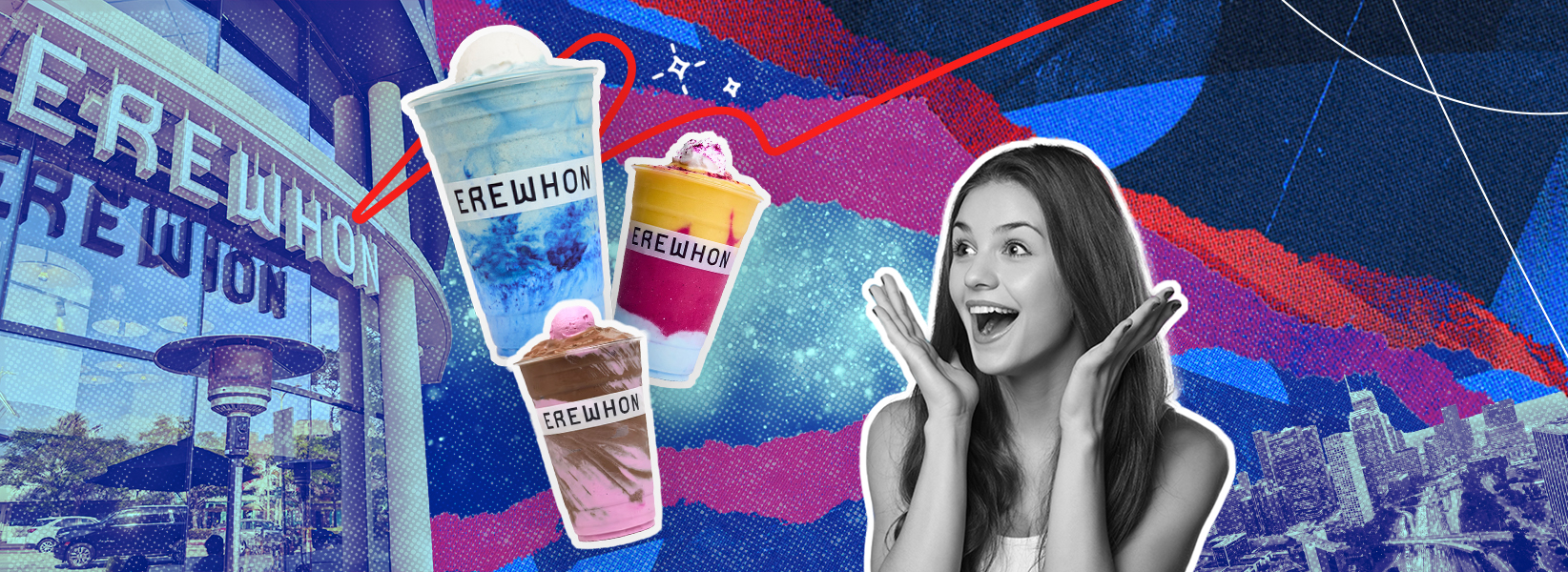
Erewhon’s Marketing Success: How Grocery Shopping Became A Status Symbol

In a fantasy land far far away, there is a grocery store where you pay $26 for bottled water, $41 for a helping of mixed berries, $22 for a smoothie, and $40 for hot sauce. Except the land is neither distant nor fantasy, it is a real chain located in California. Erewhon, a luxury health-food store with 10 locations in and around the Los Angeles area, has people in a choke-hold, but why? The owners are marketing geniuses. Simply put, the target market for Erewhon is the rich and famous. To shop at Erewhon is a luxury experience, the New York Times called it “the unofficial hangout for the young, beautiful, and bored”. Vogue described it as “Hollywood's cult-favorite wellness location." Erewhon CEO Tony Antoci claims between his 10 locations there is a whopping $900,000 per location per week, so how did they even get to this point? Organically, he claimed, but not by magic.

Tony Andoci and Josephine Andoci, Owners of Erewhon. (The Hollywood Reporter)

Tony has been in the food business since age 17, starting with phone orders at a restaurant where he met his wife Josephine, who worked in the kitchen. These two have grown Erewhon to unprecedented heights since 2011 when they purchased it. If I cringe getting the essentials, a $5 carton of eggs and a $4 gallon of milk, how did they get people to voluntarily put a $20 gallon of milk and an $11 carton of eggs (yes, really) in their shopping cart? From a marketing perspective, Erewhon is genius. Celebrity clientele, social media, their viral smoothie collaborations, quality, and store design are the best explanations for the phenomenon of Erewhon. Erewhon really took off in 2019 after a new deal with New York-based growth equity firm Stripes Group, who invested money into opening more stores and expanding their location. However, marketing machine Erewehon did not just become successful with money thrown at it and some luck, The Antoci’s are experts as well. Tony Antoci started off with a humbler beginning, selling private-label bottled water with his brother Vito to high-end restaurants on the Westside, then upgrading to selling bar supplies like olives, lemons and cherries, shortly after they started this, Josephine joined their team. At an Italian Restaurant one day an employee familiar with their business asked Josephine to start selling parmigiano-reggiano, this marked their entry to the food space, and they began selling $90 million worth of products to various vendors each year.

Years later, Erewhon is one of the face’s of organic, healthy, high-value groceries in California and online. They claim to be “driven to enhance the health of [their] community by providing organic, ethically sourced foods that support our bodies and our planet…’. Erewhon says on their website: “We’re more than a grocery store. We’re a community” right… I’m skeptical. But alas, the community in question involves affluent individuals in the area and a network of A-List celebrities including the Kardashian-Jenner family, Miley Cyrus, Hailey Bieber, Leonardo DiCaprio and more.

Seeing dozens of celebrities voluntarily shop anywhere will naturally gather attention and publicity, which was the case for Erewhon. Combining this insane publicity with their hot social media presence and buzz, their organic and quality ingredients, and their conveniently placed stores that happen to all be in affluent areas around the LA area, makes for the perfect concoction of success. People in these communities have a higher disposable income to spend on the things they want, making Erewhon a frequented destination for many.
See and be seen (Product collabs) and smoothies

Erewhon’s celebrity smoothie collaborations are nothing short of a marketing masterclass, transforming health drinks into Instagrammable status symbols. Picture this: a $22 smoothie created by the hands of A-listers like Hailey Bieber and Kendall Jenner, each sip wrapped in an aura of exclusivity. These partnerships don't just sell smoothies; they sell a lifestyle that screams "luxury wellness." With every star-studded launch, social media lights up, creating a ripple effect that attracts both die-hard fans and curious onlookers. Erewhon expertly leverages this hype, ensuring that their smoothies are the talk of the town, or rather, the talk of the high-end grocery scene. By aligning with celebrity culture, they’ve elevated the humble smoothie into a must-have accessory for anyone keen to rub elbows with the elite—because who wouldn’t want to sip on a concoction made famous by their favorite star?

Despite the fun that people (I) poke at Erewhon, they have a lot of philanthropy and community involvement to show as well. Erewhon partners with charities to donate over 25 million pounds of food to local communities, reuses or gives their waste to a sustainable recycling company, donates a portion of proceeds, and works with small businesses and farmers by promoting and selling their products. So customers can rest knowing that a portion of their $300 grocery bill, goes to various good causes. So maybe Erewhon is not so bad, I mean where else are we supposed to get our camel's milk, sea moss gel, yuzu juice, and kelp noodle chow mein all in one place?

September 24, 2024

Hue’s Who: Why Color Psychology Shapes Branding Success and Differentiation

Whether to generate conversations or play off emotions, fuel hunger or create trust, humans are influenced by color. Colors are one of the most important things in the world of marketing and advertising and the significance of strong color palette cannot be overstated. Selecting the right color combo is not merely a design choice; it’s a critical factor in customer retention, brand identity, and can even help or hurt your sales.

But why are color palettes important? They affect perception, mood, brand recognition, and consistency.1 Colors influence consumer behavior in profound ways. For instance, red is often associated with excitement and urgency, making it effective for promotions and calls to action, “Add to Cart”, and “Click Here”. Orange conveys playfulness and warmth, appealing to creativity and friendliness. Think of Nickelodeon as a brand, and their orange logo will make a lot of sense. Yellow is linked to happiness and optimism, think rubber duckies, sunshine, and smiley faces. Yellow also grabs intention, Matt Groening, creator of the Simpsons, says that he made the characters yellow because: “he wanted his cartoon to be eye-catching. When someone is flipping through channels, he wanted the bright yellow color of the Simpsons to catch the eye and make them go back to watch it."2 Green represents freshness, stability, and vitality, making it ideal for brands focused on health, quality, and sustainability such as Whole Foods or Hello Fresh. Blue fosters a sense of calm and trust, therefore it’s a popular choice for financial and healthcare brands such as Blue Cross or Chase. Purple, often associated with luxury and introspection, can inspire luxury and creativity, which is consistent with Cadbury’s branding.

“When SEO company Reboot ran a study on logo recognition, 78% of participants were able to recall the primary color of the logo while only 43% were able to remember the company name.”3 This underscores how essential a consistent color scheme is for building brand identity; the most successful companies are examples of this. Tiffany blue, John Deere green, UPS brown, Home Depot orange, and Barbie pink are all recognizable to the vast majority of the US population, which is essentially free marketing and customer recognition by something as simple as a color. Some companies go as far as to trademark “their color”, to ensure originality and unique brand identity, not to confuse themselves with any other competitor or brand. Your colors should be synonymous with your brand, a big decision we know, but it can get your brand ahead and make you more recognizable, while also helping you stand out from your competitors.

Two brands that commonly stand out in this conversation are Purple and Dunkin’. In a world of neutral marketing for mattresses and sleep companies, Purple’s lavender color and marketing stick out in the best way. Sealey, Simmons, Tempurpedic, Sleeptronic, Casper, Helix, and Mattress Firm are all either blue or red, and Purple knew exactly what they were doing with their branding. They went as far as to make the mattresses themselves purple, adding to their brand recognition in the most genius way possible. This playful color and branding also make them more approachable and humorous. As for Dunkin, they stand out for their iconic color scheme, you can picture the exact shades of pink and orange when someone says Dunkin, they have been so consistent with these colors since 1960. 

The impact of color in branding is undeniable; it’s a powerful tool that shapes perceptions and drives consumer behavior. As we’ve seen with brands like Purple and Dunkin’, a well-thought-out color palette not only differentiates a brand but also creates an emotional connection with consumers. It’s more than just aesthetics; it’s about crafting an identity that resonates and sticks. When you choose your colors wisely, you’re not just painting a pretty picture—you’re laying the groundwork for recognition, loyalty, and ultimately, success. 

1: Chamber of Commerce. (n.d.). Guide to color psychology in marketing. 

2: Woolford, M. Matt Groening explains why The Simpsons are yellow. Joe.  

3: WordStream. Color Psychology in Marketing: How Colors Influence Consumer Behavior.  

September 10, 2024

How to Succeed as An Intern: A Journey into the Unknown

Starting an internship in an established industry isn’t always easy, but preparing yourself for the possibilities is just one of the few initiatives that can help lead to a successful learning experience.


  1. Dedication: Maintaining a willingness to learn new content and complete unfamiliar tasks shows dedication to the position. However, being asked to do things that may confuse you at first glance is normal, but that is part of the learning process. In fact, one of the most important responsibilities during an internship is remaining optimistic and ensuring an open mindset. Stepping out of your comfort zone can be tricky, but it is all a part of the process and must be embraced.


  1. Ask Questions: Studying your environment and learning about your colleagues can prevent miscommunication or uncomfortable encounters. Engaging in conversation or simply asking questions to learn more should not be feared as it shows interest. In doing so, you may also form connections along the way.


  1. Stay Connected: Building connections can provide guidance, support, and insights that will be valuable throughout your career. Networking during your internship is important, as it can lead to lasting professional relationships and potentially open future opportunities.


  1. Show Effort: Putting your best foot forward can make an impact in the storytelling of your craft. Exhibiting laziness during the process of tasks can easily stain first impressions and even jeopardize workflow. Regardless of the task, trying your best shows enthusiasm, and can be seen through work quality.


  1. Reflect: Accepting failure and trying to correct future mistakes is far more purposeful than not trying at all. This proactive approach helps build a reputation for reliability and competence — setting you apart as a valuable team member, and enhancing personal and professional growth.


As an intern for KingFish Media, I have experienced the various steps of contributing to an established, passionate team. My steps are reflective of my personal story and while I do believe everyone’s varies, it is the little decisions and efforts that write your journey.

June 6, 2024

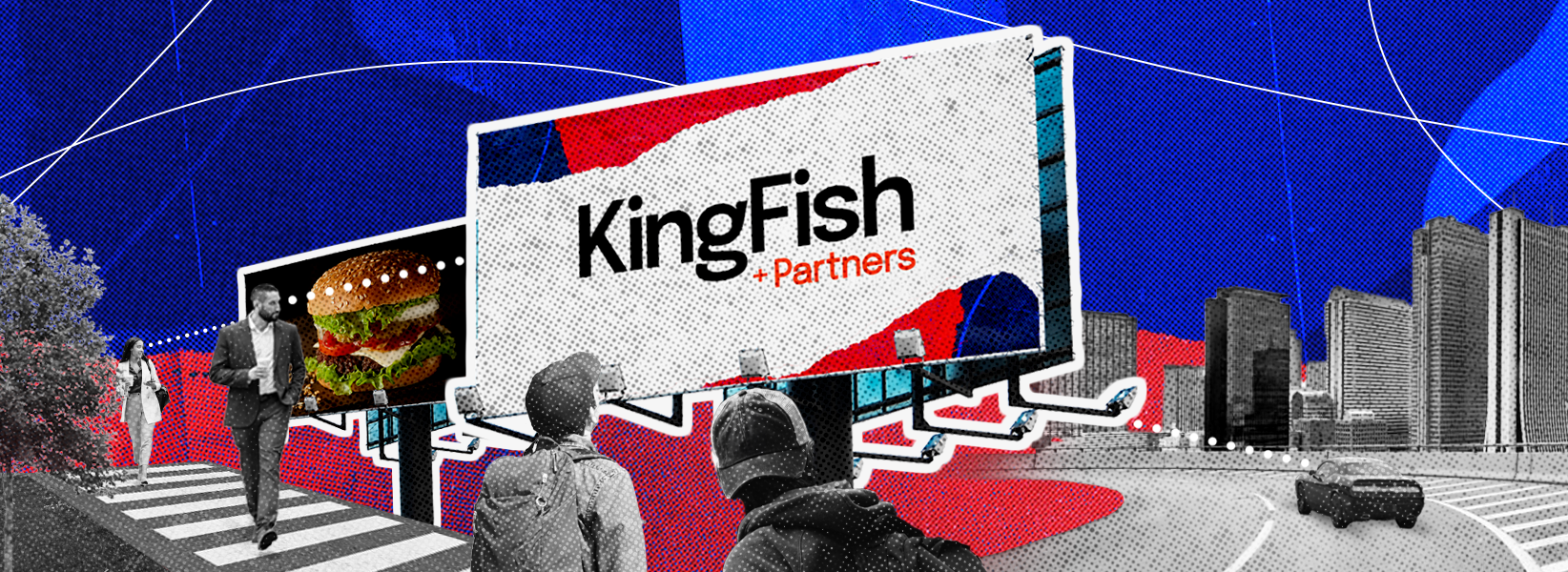
What’s the ROI of a Billboard?

Anyone can create a digital ad, but not every company can take over the side of an entire building.

When they do, it sends a strong signal to consumers: we’re the real deal. 

People driving down the highway who see a McDonald’s billboard aren’t going to suddenly cut across four lanes of traffic to buy a quarter pounder with cheese, but the next time they’re hungry, they might consider buying one. (And maybe some nuggets, too.)

We’re strong advocates for billboards for clients with certain campaign objectives.

They help brands stand out in a crowded digital market and offer legitimacy.

Asking “What’s the ROI of a billboard?” is the wrong question.

That’s sales. Let’s talk branding instead.

Branding is...

  • Making future sales easier
  • Staying top of mind
  • Building trust
  • Gaining awareness (visibility)
  • Creating an emotional connection
  • Storytelling
  • Big-picture thinking

For this, we don’t measure ROI.

Not everything valuable can be quantified, and even measurable data can be inaccurate.

Consider this: people generally buy products and services from companies they know and trust. To become a company that people know and trust, you must first be visible.

Billboards should be considered as an element of a comprehensive multi-channel strategy.

May 25, 2024

Brand Activism: Deterrent or Loyalty-Builder?

Anheuser-Busch's recent collaboration with transgender social media influencer, Dylan Mulvaney, sought to generate publicity for Bud Light during the NCAA March madness tournament this spring. What resulted was an enormous controversy that sparked a mass call to boycott the brand. The overwhelming backlash that Anheuser-Busch received for working with Mulvaney will undoubtedly have significant repercussions into the future as corporations weigh the outcomes of explicitly promoting their values in marketing campaigns, or even just implicating their values as was done with this recent collaboration with Mulvaney. With a backdrop of increasingly divisive politics in the US, brands must decide whether to advocate for social issues and risk alienating some of their consumer base or remain neutral in the face of heated current events.

Brand activism isn’t new

Partisan politics appearing in marketing is not a new phenomenon. Issues like abortion rights, BLM, LGBTQ+ visibility, and gun laws are just several of the hotly debated topics that have surfaced over the past couple decades as businesses engage with brand activism. Over ten years ago, JC Penney launched a campaign that featured a lesbian couple and their daughter. The campaign was met with outrage from some, including the conservative mother’s group One Million Moms who protested the company on the basis of “protecting their children” (Block, 2012). Other brands have similarly incited controversy due to treading in political waters. For example, Disney’s CEO Bob Chapek explicitly opposed Florida’s ‘Don’t Say Gay Bill,’ resulting in Gov. Ron DeSantis’ attempt to revoke the corporation’s special land tax status. In 2018, Nike featured Colin Kaepernick in their Just Do It campaign with the message “Believe in something. Even if it means sacrificing everything” after the football quarterback kneeled in protest during the National Anthem. Nike initially lost 3% in its share prices, but within four days the brand’s online sales increased by 31% (Birch, 2022).

Consumer Brand Identification: a theoretical framework

So, is the risk of controversy and negative press worth it for these companies to engage in brand activism that could potentially generate stronger customer loyalty? From a theoretical perspective, Consumer Brand Identification Theory explains how self-identification affects loyalty (and disloyalty) to certain brands. This framework posits that agreement/disagreement between the self and the brand is the basis for consumers’ decision-making in supporting or renouncing a brand. Researchers Sourjo Mukherjee and Niek Althuzien found that brand-identification produces an asymmetric effect, contrary to previous studies demonstrating that self-brand agreement generally leads to positive marketing results (2020). That is, while self-brand disagreement regarding a brand’s values produces negative attitudes toward the brand, self-brand agreement did not generate a significant change in attitude toward the brand. This asymmetric effect on consumer attitudes and behaviors would suggest that taking a social stance only results in negative outcomes, and not vice versa.

Behaviors and attitudes in the real world

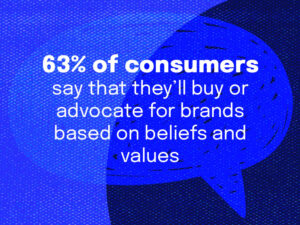
Consumer brand-identification is a strong theoretical foundation, but real people seem to have different perspectives about brand activism. According to a 2018 study by Sprout Social, almost two-thirds of consumers want brands to connect with them, regardless of political affiliation. On top of that, the survey found that 78% want brands to use their social presence to bring people together.Despite the seemingly asymmetric effects of brand-identification theory, real consumers want and expect brands to use their social platforms to spread positive values and connect people. Data from the 2023 Edelman Trust survey corroborates these results with 63% of consumers saying that they buy or advocate for brands based on beliefs and values. Consumers recognize the power of social media and are looking for companies to speak about relevant socio-political issues on their platforms.

The jury’s out…

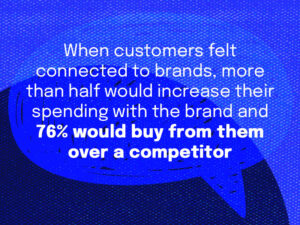
The jury’s still out on whether activism in marketing is advantageous in the long term or if it risks driving away consumers. Some argue that brands’ addressing social issues only exacerbates political polarization and alienates customers with opposing views (Zahn, 2022). However, there is also evidence supporting the idea that taking a stance can lead to increased consumer loyalty. The Edelman survey found that when customers felt connected to brands, more than half would increase their spending with the brand and 76% would buy from them over a competitor (2023). With all this said, brands need to prioritize the issues important to their customer base to build stronger connections and ultimately increase sales. Aerie, for example, has incorporated #AerieREAL into their branding which celebrates body inclusivity and fosters much stronger customer relationships. There’s a lot to consider when connecting with and appealing to a certain consumer base – customer expectations and age demographics just to name a couple of things. Ultimately, the choice to engage in socio-political brand activism relies on building a connection with consumers, leading to greater brand loyalty and increased sales for the company.

May 12, 2024

Breaking the Mold: Creative Risk Takers

Sometimes, creatives get a bad rap. There’s this conventional wisdom that they are difficult or have fragile egos. They are called prima donnas, although rarely to their faces. They are lumped together as a “type” as in, “oh, you know, he’s a creative type”. Of course, these problematic behaviors are worth putting up with to receive the products of those inventive minds. To those claims I call bullshit – creatives are in fact the soul of marketing. 

In reality, creatives inspire a thoughtful workplace. They try things, push boundaries. They are risk takers. And when they fall short, they always make it better the next time. 

Creatives possess a unique capacity and are amazingly capable of taking critical feedback to their work. They have been trained to look at assignments as an evolutionary process and are rarely pissed or disappointed when you provide constructive criticism. 

In truth, I have enormous capacity for dumb ideas — my own and those of others. How will we get to the great ones if we don’t throw it all on the table? I don’t mean to imply that it’s a free-for-all — we do have discipline in place. We use creative briefs and other guiding tools to keep the team focused and on point. Chaos in the classic sense is not part of any creative process. 

We mostly leave our creative team to its own devices. The account and strategy teams set out to be clear in their expectations and direction with particular regard to deadlines. They classify and illuminate when needed. After that it’s the creatives’ responsibility to deliver. 

Check out The Top 16 Reasons to Work at a Small Agency. Except for the last two reasons, that are a bit tongue-in-cheek, all are meaningful to me. But I think the most important may be #6. When we challenge each other, it’s not company politics. It’s about doing our best work. For the client and for ourselves. There is enormous satisfaction in seeing an idea play out, through inspired graphic design, razor-sharp writing and overall execution that just crushes it. 

To a person we all value everyone on our team, and we show that through words and actions. A core value here is to preach and practice respect; I appreciate generosity of spirit and hope that I exhibit the same. And I am grateful for the creatives who with their own interpretations bring our concepts to life. 

I can’t be the only one. What’s your experience working with creatives? True to the stereotype or pleasant surprise? 

April 13, 2024

3 Reasons to Add a Small Agency to Your Short List

Businesses of all sizes can find the perfect fit in a small agency partner. Whether you’re a small to mid-sized business that needs a website redesign or a large business with a specialty project your AOR isn’t the right fit for, a small agency deserves the chance to compete for the work.  

Here are three reasons you should add a small agency to your agency short list: 

We are lean (for real)

Have you ever been in a meeting with an agency, and there is one (or more) person staring into their laptops or phones not saying a word? Here is a fun game: think about how much you are paying for that person to work on something that is not your business. It is a bummer.  

At King Fish, we are all thinkers, doers, and collaborators and contribute significantly to our projects. If we are at the table, we bring value. We do not do hierarchy. We accomplish more with less. That means your budget, time, energy, and resources go much, much further with us than with an agency with a deep roster.  

Our network is your competitive advantage

Small agencies might have a handful of full-time employees, but they can tap into a wide network of talented contractors and experienced subject matter experts to build a customized project team for each client when needed. Big agencies staff excellent creative talent, but they often lack the subject matter expertise that is critical for marketing to B2B consumers or doing the deep-thinking work required of regulatory clients in the finance, healthcare, and technology industries.  

At KingFish, we utilize our network to staff projects with the copywriters, user experience designers, and developers most qualified to deliver the best possible work for you. They are masters of their skill and understand (and often live) your business. It is a winning combination.  

We are in it for the work, not the perks

Big agencies can have their big-city surroundings, kegs, pool tables, video games, snack drawers, and open bar black-tie holiday parties. Sure, we enjoy our deck beers and concert outings — but what encourages us to come to work every morning is the impact we have on our clients’ businesses. That’s the true reward, and it shines through in how we collaborate with each other and our clients. You’ll feel the difference. 

Speaking of the work, check out our case studies for a look inside some of our favorite projects and keep us in mind the next time you are in the market for an agency. 

Independent.
Full service.
24 years and running.

We’re always down to put heads together. Reach out to kick off a new partnership.

kingfish-logo-square
kingfish-partners-text-logo-footer-v4

© KINGFISH | KINGFISH + PARTNERS™ IS A TRADEMARK OF KING FISH MEDIA, LLC.
© 2025 WETWARE | WETWARE™ IS A TRADEMARK OF KING FISH MEDIA, LLC.
PRIVACY | TERMS